This week is the 2023 DOE experimental condensed matter physics PI meeting - in the past I’ve written up highlights of these here (2021), here (2019), here (2017), here (2015), and here (2013). This year, I am going to have to present remotely, however, because I am giving a talk at this interesting conference at the Kavli Institute for Theoretical Physics. I will try to give some takeaways of the KITP meeting, and if any of the ECMP attendees want to give their perspective on news from the DOE meeting, I’d be grateful for updates in the comments.
Sunday, September 17, 2023

Thursday, September 07, 2023
Things I learned at the Packard Foundation meeting
Early in my career, I was incredibly fortunate to be awarded a David and Lucille Packard Foundation fellowship, and this week I attended the meeting in honor of the 35th anniversary of the fellowship program. Packard fellowships are amazing, with awardees spanning the sciences (including math) and engineering, providing resources for a sustained period (5 years) with enormous flexibility. The meetings have been some of the most fun ones I've ever attended, with talks by incoming and outgoing fellows that are short (20 min) and specifically designed to be accessible by scientifically literate non-experts. My highlights from the meeting ten years ago (the last one I attended) are here. Highlights from meetings back when I was a fellow are here, here, here, here.
Here are some cool things that I learned at the meeting (some of which I'm sure I should've known), from a few of the talks + posters. (Unfortunately I cannot stay for the last day, so apologies for missing some great presentations.) I will further update this post later in the day and tomorrow.
- By the 2040s, with the oncoming LISA and Cosmic Explorer/Einstein Telescope instruments, it's possible that we will be able to detect every blackhole merger in the entire visible universe.
- It's very challenging to have models of galaxy evolution that handle how supernovae regulate mass outflow and star formation to end up with what we see statistically in the sky
- Machine learning can be really good at disentangling overlapping seismic events.
- In self-propelled/active matter, it's possible to start with particles that just have a hard-shell repulsion and still act like there is an effective attractive interaction that leads to clumping.
- There are about \(10^{14}\) bacteria in each person, with about 360\(\times\) the genetic material of the person. Also, the gut has lots of neurons, five times as many as the spinal cord (!). The gut microbiome can seemingly influence concentrations of neurotransmitters.
- Bees can deliberately damage leaves of plants to stress the flora and encourage earlier and more prolific flowering.
- For some bio-produced materials that are nominally dry, their elastic properties and the dependence of those properties on humidity is seemingly controlled almost entirely by the water they contain.
- It is now possible to spatially resolve gene expression (via mRNA) at the single cell level across whole slices of, e.g., mouse brain tissue. Mind-blowing links here and here.
- I knew that ordinary human red blood cells have no organelles, and therefore they can't really respond much to stimuli. What I did not know is that maturing red blood cells (erythrocyte precurors) in bone marrow start with nuclei and can participate in immune response, and that red blood cells in fetuses (and then at trace level in pregnant mothers) circulate all the different progenitor cells, potentially playing an important role in immune response.
- 45% of all deaths in the US can be attributed in part to fibrosis (scarring) issues (including cardiac problems), but somehow the uterus can massively regenerate monthly without scarring. Also, zero common lab animals menstruate, which is a major obstacle for research; transgenic mice can now be made so that there are good animal models for study.
- Engineered cellulose materials can be useful for radiative cooling to the sky and can be adapted for many purposes, like water harvesting from the atmosphere with porous fabrics.
Thursday, August 31, 2023
What is the thermal Hall effect?
One thing that physics and mechanical engineering students learn early on is that there are often analogies between charge flow and heat flow, and this is reflected in the mathematical models we use to describe charge and heat transport. We use Ohm's law, \(\mathbf{j}=\tilde{\sigma}\cdot \mathbf{E}\), which defines an electrical conductivity tensor \(\tilde{\sigma}\) that relates charge current density \(\mathbf{j}\) to electric fields \(\mathbf{E}=-\nabla \phi\), where \(\phi(\mathbf{r})\) is the electric potential. Similarly, we can use Fourier's law for thermal conduction, \(\mathbf{j}_{Q} = - \tilde{\kappa}\cdot \nabla T\), where \(\mathbf{j}_{Q}\) is a heat current density, \(T(\mathbf{r})\) is the temperature distribution, and \(\tilde{\kappa}\) is the thermal conductivity.

We know from experience that the electrical conductivity really has to be a tensor, meaning that the current and the electric field don't have to point along each other. The most famous example of this, the Hall effect, goes back a long way, discovered by Edwin Hall in 1879. The phenomenon is easy to describe. Put a conductor in a magnetic field (directed along \(z\)), and drive a (charge) current \(I_{x}\) along it (along \(x\)), as shown, typically by applying a voltage along the \(x\) direction, \(V_{xx}\). Hall found that there is then a transverse voltage that develops, \(V_{xy}\) that is proportional to the current. The physical picture for this is something that we teach to first-year undergrads: The charge carriers in the conductor obey the Lorentz force law and curve in the presence of a magnetic field. There can't be a net current in the \(y\) direction because of the edges of the sample, so a transverse (\(y\)-directed) electric field has to build up.
There can also be a thermal Hall effect, when driving heat conduction in one direction (say \(x\)) leads to an additional temperature gradient in a transverse (\(y\)) direction. The least interesting version of this (the Maggi–Righi–Leduc effect) is in fact a consequence of the regular Hall effect: the same charge carriers in a conductor can carry thermal energy as well as charge, so thermal energy just gets dragged sideways.
Surprisingly, insulators can also show a thermal Hall effect. That's rather unintuitive, since whatever is carrying thermal energy in the insulator is not some charged object obeying the Lorentz force law. Interestingly, there are several distinct mechanisms that can lead to thermal Hall response. With phonons carrying the thermal energy, you can have magnetic field affecting the scattering of phonons, and you can also have intrinsic curving of phonon propagation due to Berry phase effects. In magnetic insulators, thermal energy can also be carried by magnons, and there again you can have Berry phase effects giving you a magnon Hall effect. There can also be a thermal Hall signal from topological magnon modes that run around the edges of the material. In special magnetic insulators (Kitaev systems), there are thought to be special Majorana edge modes that can give quantized thermal Hall response, though non-quantized response argues that topological magnon modes are relevant in those systems. The bottom line: thermal Hall effects are real and it can be very challenging to distinguish between candidate mechanisms.
(Note: Blogger now compresses the figures, so click on the image to see a higher res version.)
Wednesday, August 23, 2023
Some interesting recent papers - lots to ponder
As we bid apparent farewell to LK99, it's important to note that several other pretty exciting things have been happening in the condensed matter/nano world. Here are a few papers that look intriguing (caveat emptor: I have not had a chance to read these in any real depth, so my insights are limited.)
- Somehow I had never heard of Pines' Demon until this very recent paper came out, and the story is told briefly here. The wikipedia link is actually very good, so I don't know that I can improve upon the description. You can have coupled collective modes for electrons in two different bands in a material, where the electrons in one band are sloshing anti-phase with the electrons in the other band. The resulting mode can be "massless" (in the sense that its energy is linearly proportional to its momentum, like a photon's), and because it doesn't involve net real-space charge displacement, to first approximation it doesn't couple to light. The UIUC group used a really neat, very sensitive angle-resolved electron scattering method to spot this for the first time, in high quality films of Sr2RuO4. (An arxiv version of the paper is here.)
- Here is a theory paper in Science (arxiv version) that presents a general model of so-called strange metals (ancient post on this blog). Strange metals appear in a large number of physical systems and are examples where the standard picture of metals, Fermi liquid theory, seems to fail. I will hopefully write a bit more about this soon. One of the key signatures of strange metals is a low temperature electrical resistivity that varies like \(\rho(T) = \rho_{0} + AT\), as opposed to the usual Fermi liquid result \(\rho(T) = \rho_{0} + AT^{2}\). Explaining this and the role of interactions and disorder is a real challenge. Here is a nice write-up by the Simons Foundation on this.
- Scanning tunneling microscopy is a great spectroscopic tool, and here is an example where it's been possible to map out information about the many-body electronic states in magic-angle twisted bilayer graphene (arxiv version). Very pretty images, though I need to think carefully about how to understand what is seen here.
- One more very intriguing result is this paper, which reports the observation of the fractional quantum anomalous Hall effect (arxiv version). As I'd mentioned here, the anomalous Hall effect (AHE, a spontaneous voltage appearing transverse to a charge current) in magnetic materials was discovered in 1881 and not understood until recently. Because of cool topological physics, some materials show a quantized AHE. In 2D electron systems, the fractional quantum Hall effect is deeply connected to many-body interaction effects. Seeing fractional quantum Hall states spontaneously appear in the AHE is quite exciting, suggesting that rich many-body correlations can happen in these topological magnetic systems as well. Note: I really need to read more about this - I don't know anything in depth here.
- On the more applied side, this article is an extremely comprehensive review of the state of the art for transistors, the critical building block of basically every modern computing technology. Sorry - I don't have a link to a free version (unless this one is open access and I missed it). Anyway, for anyone who wants to understand modern transistor technology, where it is going, and why, I strongly encourage you to read this. If I was teaching my grad nano class, I'd definitely use this as a reference.
- Again on the applied side, here is a neat review of energy harvesting materials. There is a lot of interest in finding ways to make use of energy that would otherwise go to waste (e.g. putting piezo generators in your clothing or footwear that could trickle charge your electronics while you walk around).
- In the direction of levity, in all too short supply these days, xkcd was really on-point this week. For condensed matter folks, beware the quasiparticle beam weapon. For those who do anything with electronics, don't forget this handy reference guide.
Thursday, August 17, 2023
Neutrality and experimental detective work
One of the remarkable aspects of condensed matter physics is the idea of emergent quasiparticles, where through the interactions of many underlying degrees of freedom, new excitations emerge that are long-lived and often can propagate around in ways very different than their underlying constituents. Of course, it’s particularly interesting when the properties of the quasiparticles have quantum numbers or obey statistics that are transformed from their noninteracting counterparts. For example, in the resonating valence bond model, starting from electrons with charge \(-e\) and spin 1/2, the low energy excitations are neutral spin-1/2 spinons and charge \(e\) holons. It’s not always obvious in these situations whether the emergent quasiparticles act like fermions (obeying the Pauli principle and stacking up in energy) or bosons (all falling into the lowest energy state as temperature is reduced). See here for an example.
Suppose there is an electrically insulating system that you think might host neutral fermionic excitations. How would you be able to check? One approach would be to look at the low temperature specific heat, which relates how much the temperature of an isolated object changes when a certain amount of disorganized thermal energy is added. The result for (fermionic) electrons in a metal is well known: because of the Pauli principle, the specific heat scales linearly with temperature, \(C \sim T\). (In contrast, for the vibrational part of the specific heat due to bosonic phonons, \(C \sim T^3\) in 3D.). So, if you have a crystalline(*) insulator that has a low temperature specific heat that is linear in temperature (or, equivalently, when you plot \(C/T\) vs. \(T\) and there is a non-zero intercept at \(T=0\)), then this is good evidence for neutral fermions of some kind. Such a system should also have a linear-in-\(T\) thermal conductivity, too, and an example of this is reported here. This connects back to a post that I made a month ago. Neutral fermions (presumably carrying spin) can lead to quantum oscillations in the specific heat (and other measured quantities).
This kind of detective work, considering which techniques to use and how to analyze the data, is the puzzle-solving heart of experimental condensed matter physics. There is a palette of measurable quantities - how can you use those to test for complex underlying physics?
(*) It’s worth remembering that amorphous insulators generally have a specific heat that varies like \(T^{1.1}\) or so, because of the unreasonably ubiquitous tunneling two-level systems. The neutral fermions I’m writing about in this post are itinerant entities in nominally perfect crystals, rather than the localized TLS in disordered solids.
Friday, August 11, 2023
What is a metal-insulator transition?
The recent excitement about the alleged high temperature superconductor "LK99" has introduced some in the public to the idea of a metal-insulator or insulator-metal transition (MIT/IMT). For example, one strong candidate explanation for the sharp drop in resistance as a function of temperature is a drastic change in the electronic (and structural) properties of Cu2S at around 328 K, as reported here.
In condensed matter physics, a metal is usually defined as a material with an electrical conductivity that increases with decreasing temperature. More technically, in a (macroscopic) metal it is possible to create an electronic excitation (moving some electron from one momentum to another, for example) at arbitrarily small energy cost. A metal is said to have "gapless excitations" of the electrons. Even more technically, a metal has a nonzero electronic density of states at the electronic chemical potential.
In contrast, an insulator has an electronic conductivity that is low and decreases with decreasing temperature. In an insulator, it costs a non-zero amount of energy to create an electronic excitation, and the larger that energy cost, the more insulating the material. An insulator is said to have an "energy gap". If that energy gap is small compared to the thermal energy available (\( \sim k_{\mathrm{B}}T\)), there will be some conduction because of thermally excited electrons (and holes). One way to classify insulators is by the reason for the energy gap, though knowing the mechanism for certain is often challenging. A material is a "band insulator" if that gap comes about just because of how the atoms are stacked in space and how each atom shares its electrons. This is the case for diamond, for example, or for common semiconductors like Si or GaAs (called semiconductors because their energy gaps are not too large). A material can be an insulator due primarily to electron-electron interactions (a Mott insulator or the related charge transfer insulator); a material can be an insulator primarily because of interactions between the electrons and the lattice structure (a Peierls insulator); a material can be an insulator because of disorder, which can lead to electrons being in localized states (an Anderson insulator).
In some materials, there can be a change between metallic and insulating states as a function of some physically tunable parameter. Common equilibrium control knobs are temperature, pressure, magnetic field, and density of charge carriers. It's also possible to drive some materials between insulating and metallic states by hitting them with light or applying large electric fields.
Sudden changes in properties can be very dramatic, as the Cu2S case shows. That material tends to be in one crystal structure at high temperatures, in which it happens to be a band insulator with a large gap. Then, as the temperature is lowered, the material spontaneously changes into a different crystal structure in which there is much more conduction. There are other materials well known for similar transitions (often between a high temperature conducting state and a low temperature insulating state), such as VO2 and V2O3, in which the electrical conductivity can abruptly change by 5 orders of magnitude over a small temperature range.
MIT/IMT materials can be of technological interest, particularly if their transitions are readily triggered. For example, vanadium oxides are used in thermochromic and electrochromic switchable windows, because the optical properties of the material are drastically different in the conducting vs insulating phases. The fundamental interest in MIT/IMTs systems is clear as well, especially when electronic interactions are thought to be responsible - for example, the rich array of conducting, superconducting, and insulating states that show up in twisted bilayer graphene as a function of carrier density (a representative paper here). It's always interesting to consider how comparatively simple ingredients can lead to such rich response, through energetic (and entropic) competition between different states with wildly disparate properties.
Sunday, August 06, 2023
Desirable properties for a superconductor
Given the present interest, let's talk about what kind of properties one wants in a superconductor, as some people on social media seem ready to jump straight on the "what does superconductivity mean for bitcoin?" train.
First, the preliminaries. Superconductivity is a state of matter in which the conduction electrons act collectively in an interesting way. In the superconductors we know about, electrons pair up and can be described by a single collective quantum state (with a well-defined phase - the quantum state can be written as a complex quantity that has an amplitude and a phase angle, as in \(A \exp{i\phi}\), where \(\phi\) is the phase). A consequence of this is that there is an "energy gap" - it costs a certain amount of energy to create individual unpaired electrons. It's this energy gap that allows dc current to flow without electrical resistance in a superconductor. There is a length scale, the coherence length, over which the superconducting state tends to vary, like at the boundary of a material. There is also a length scale, the penetration depth, over which magnetic field can penetrate into a superconductor. Magnetic field is expelled from the bulk of a superconductor because the material spontaneously develops surface currents such that the field from those currents cancels out the external field in the bulk of the material. Depending on the ratio of the coherence length and the penetration depth, a superconductor can be Type I (expels all magnetic field until the field \(H\) exceeds some critical value \(H_{c}\), at which point superconductivity dies) or Type II (allows magnetic field above a critical field \(H_{c1}\) to penetrate in the form of vortices, with a non-superconducting core and surrounded by screening currents, until superconductivity is eventually killed above some upper critical field \(H_{c2}\)). Motion of vortices actually leads to energy losses, so it is desirable for applications involving AC currents especially to have the vortices be pinned in place somehow in the material, often by disorder. It is this pinning that leads to superconducting levitation in fixed orientations relative to a magnet, even with the SC hanging below the magnet. Superconductivity tends to die either by the pairs falling apart (common in Type I superconductors as temperature is increased until thermal energy exceeds the attractive pairing interaction) or by the loss of global phase coherence (a crude analogy: the dance partners are still paired up, but each pair is dancing to their own tune).
Superconductors have a critical temperature above which global superconductivity is lost. They also have critical field scales, as mentioned above. Clearly, for many applications, it would be greatly desirable for a superconductor to have both a high critical temperature (obviously) and high critical fields. Similarly, superconductors have a critical current density - some combination of the local field (from the current) exceeding the critical field and current-driven phase slips can lead to loss of superconductivity. It would be great to have a high critical current density. The relationship between critical temperature, critical field, and critical current density is not always simple, though they tend to correlate, because if SC is very robust all three quantities will tend to be larger.
It would also be wonderful if a new superconducting family of materials was ductile. The higher temperature superconductors (cuprates, pnictides, nickelates) are all ceramics, meaning that they are brittle and not readily formed into wires. It's taken 36 years or so for people to get good at making wires and ribbons that incorporate the cuprate superconductors, typically by encasing them in powder form inside Cu or Ag tubes, then squeezing appropriately and annealing.
Lastly, and perhaps not well appreciated, from a practical perspective, it'd be nice if superconductors were air stable. That is, it's annoying to work with materials that react poorly to oxygen, humidity in the air, O2 or water in the presence of UV light from the sun, etc. Having a material that is chemically very stable with a clearly known and set stoichiometry would be great. Along with this, it would be nice if the material was easily made, at scale, without having to resort to crazy conditions (super high temperatures or pressures; weird rare or hazardous constituents).
How useful any candidate superconductor will be and on what timescale is set by the combination of these properties. A room temperature superconductor that turns into goo in the presence of damp air would not be nearly as useful as one that is chemically stable sitting on a bench.
For all the people who seem to be jumping to the conclusion that room temperature superconductivity will suddenly lead to breakthroughs in quantum information processing, that is far from clear. Lots of processes that screw up superconducting qubits happen more at higher temperatures, even if superconductivity is robust. I'm not aware of anyone peddling qubits based on copper oxide superconductors right now, even though the transition temperature is 10 times higher than that of Nb.
In short: usefulness does not flow instantly from materials discovery, even if the material parameters all seem good. Patience is hard to come by yet essential in trying to adapt new materials to applications.
Thursday, July 27, 2023
Condensed matter on the public stage, and not in a good way
This week, condensed matter physics has been getting far more broad public attention than usual, and while in the abstract I like our discipline getting noticed, this is definitely not how I’d have preferred it to happen.
First, more fun re Ranga Dias. Fresh off renewed controversy about claims of room temperature superconductivity in Lu-N-H at high pressures (claims of reproduction of the effect seem unreliable to me), it’s come out that this paper, already under an “expression of concern”, is being retracted. This has been widely reported - see here (hurray for student journalism) and here and here for example. It is abundantly clear that data fabrication/copying has taken place here. Between this, the other retraction, and the clear evidence of thesis content plagiarism, it’s hard to see any signs of credibility remaining.
Then there is the claim via preprints (here, here) of room temperature superconductivity at ambient pressure in a lead oxide compound from investigators in Korea. Cutting to the chase: it is very unlikely, in my view, that this pans out, for multiple reasons. Extraordinary claims hardly ever hold up. There are multiple weird issues with the data in the figures (e.g., magnetic susceptibility data that shows up in both papers with the same units but axes that differ in magnitude by a factor of 7000 - which numbers are reliable, if either? Resistivity that seem bizarrely large (0.01 Ohm-cm is bigger than the Mott-Ioffe-Regel limit - again, are the units right?). A specific heat that doesn’t reach 3R at high temperatures. Not clear of the resistance is really zero in the nominally superconducting part of the V-I curves.). That said, if the video and the not-crazy-scale susceptibility data are trustworthy, this stuff is very diamagnetic, more so than graphite, which is quite unusual. At least the authors do provide a comparatively straightforward synthesis recipe, so replication attempts should clear this up in a week or two.
None of this is thaaaaaaat unusual, by the way. There are claims of weird superconductivity at some rate. It’s easy to screw up measurements, especially in inhomogeneous materials. Unfortunately, social media (esp the site formerly known as twitter) drastically amplifies this stuff. I assume Michio Kaku is going to be on tv any second now talking about how this will change the world. Hopefully responsible journalists will be effective at pointing out that a non-reviewed preprint on the arxiv is not conclusive.
I’m traveling, so updates will be sparse, but I will try to keep an eye on the comments.
Sunday, July 23, 2023
Disorganized thoughts on "Oppenheimer"
I saw "Oppenheimer" today. Spoiler warning, I suppose, though I think we all know how this story ends. Just in case you were wondering, there is no post-credit scene to set up the sequel. (For the humor-impaired: that was a joke.)
The movie was an excellent piece of film-making, and I hope it's an opportunity for a large viewing audience to learn about a reasonable approximation of incredibly consequential history. Sure, I can nitpick about historical details (why did Nolan leave out "Now we are all sons of bitches", transfer a bet to a different person, and omit Fermi dropping bits of paper to estimate the yield of the Trinity test? Why did he show Vannevar Bush seemingly hanging out at Los Alamos? Update: rereading The Making of the Atomic Bomb, I was surprised to learn that Bush apparently was, in fact, present at the Trinity test! Also, I do now see on an updated cast list that Kistiakowsky was portrayed in the movie, so I may have been wrong about the bet as well. Mea culpa.). Still, the main points come through - the atmosphere of war-time Los Alamos, and the moral complexity and ambiguity of Oppenheimer and the bomb.
The definitive work about the Manhattan Project is The Making of the Atomic Bomb by Richard Rhodes. That book truly captures the feeling of the era and the project. Rereading it now, it still amazes how physicists and chemists of the time were able to make astonishing progress. Reading about how Fermi & co. discovered moderation of neutrons (that is, slowing of neutrons through inelastic scattering off of hydrogen-containing materials like paraffin) is just mind-blowing as an experimentalist. (They stumbled upon this by realizing that they got different experimental results if they ran their measurements on wood tables rather than marble tables within the same lab.)
I saw someone lamenting on twitter that this movie was unlikely to inspire a generation of young people to go into physics. Clearly that was not the intent of the film at all. I think it's a net positive if people come away from the movie with a sense of the history and the fact that individual personalities have enormous sway even in the face of huge historical events. Many people in the story are physicists, but the point is that they're complicated people dealing with the morality of enormously consequential decisions (on top of the usual human frailties). (One thing the movie gets right is Teller's relentless interest in "the super" and his challenges in working with others on the Manhattan Project. If Teller had been a less challenging personality, the course of nuclear weapons development may have been very different. It reminds me superficially of William Shockley, whose managerial skills or lack thereof directly led to the creation of Silicon Valley.)
For those interested in reading more about the context of the Manhattan Project, I recommend a couple of items. The Los Alamos Primer are the notes that were given to incoming Project members and make for fascinating reading, accessible at the advanced undergrad level. The Farm Hall transcripts are the transcribed recordings of interned German scientists held by the British in August, 1945. They go from denial (the Americans couldn't possibly have developed a bomb) to damage control (clearly we slow-walked everything because we didn't really want the Nazis to get nuclear weapons) in the space of a couple of days.
Sunday, July 16, 2023
What are "quantum oscillations"?
For the first time in a couple of decades, I was visiting the Aspen Center for Physics, which is always a fun, intellectually stimulating experience. (Side note: I sure hope that the rapidly escalating costs of everything in the Aspen area don't make this venue untenable in the future, and that there are growing generous financial structures that can allow this to be accessible for those of limited funding.) One of the topics of discussion this week was "quantum oscillations" in insulators, and I thought it might be fun to try to explain, on some accessible level, just how weird those observations are.
For electrons in a conducting crystal, the idea of cyclotron motion still works, though the energy of an electronic state involves both the magnetic field and the zero-field band structure. For an electron with wavevector \(\mathbf{k}\), one can define a velocity \(\mathbf{v}= (1/\hbar) \nabla_{\mathbf{k}}E(\mathbf{k})\) and use that in the Lorentz force law to figure out how \(\mathbf{k}\) varies in time. It turns out that an electron at the Fermi surface will trace out an orbit in both real space and \(\mathbf{k}\)-space. (Of course, for this physics to matter, the system has to be sufficiently free of disorder and at sufficiently low temperatures that the electrons are unlikely to scatter as they trace out orbits.)
Historically, quantum oscillations are observed in metals and (doped) semiconductors, and they have been a great tool for understanding electronic structure in conductive materials, a topic sometimes called "fermiology". First, I need to talk about Fermi surfaces.
Annoyingly, it's easiest to describe the electronic states in a crystal in terms of "reciprocal space" or \(\mathbf{k}\)-space, where the wave-like electronic states are labeled by some wavevector \(\mathbf{k}\), and have some (crystal) momentum given by \(\hbar \mathbf{k}\). ( Near the bottom of an energy band, the energy of such a state is typically something like \(E_{0} + (\hbar^2 k^2)/2m^{*}\), where \(m^{*}\) is an effective mass.)
At low temperatures, the electrons settle into their lowest energy states (toward low values of \(\mathbf{k}\)), but they stack up in energy because of the Pauli principle, so that there is some blob (possibly more than one) of filled states in \(\mathbf{k}\)-space, with a boundary called the Fermi surface, surrounded by empty states. Because the relationship between energy and momentum, \(E(\mathbf{k})\), depends on the atoms in the material and the crystal structure, the Fermi surface can be complicated and have funny shapes, like the one shown in the link. "Fermiology" is the term for trying to figure out, experimentally, what Fermi surfaces look like. This matters because knowing which electronic states are the highest occupied affects many properties that you might care about. The electrons in states right "at" the Fermi surface are the ones that have energetically nearby empty states and thus are the ones that respond to perturbations like electric fields, temperature gradients, etc.
Now turn on a magnetic field. Classically, free electrons in a magnetic field \(B\) with some velocity perpendicular to the field will tend to move in circles (in the plane perpendicular to the field) called cyclotron orbits, and that orbital motion has a characteristic cyclotron frequency, \(\omega_{c} = eB/m\). In the quantum problem, free electrons in a magnetic field have allowed energies given by \((n+1/2)\hbar \omega_{c}\). Since there are zillions of conduction electrons in a typical chunk of conductor, that means that each of these Landau levels holds many electrons.
 |
| An electron with wavevector \(\mathbf{k}\) in a magnetic field \(\mathbf{B}\) will trace out an orbit (yellow) in \(\mathbf{k}\)-space. |
Now imagine sweeping the magnetic field. As \(B\) is ramped up, discrete cyclotron energy levels will sweep past the energy of the highest occupied electronic states, the Fermi surface. That coincidence, when there are a lot of electronic states at the Fermi energy coinciding with a cyclotron level, leads to a change in the number of electronic states available to undergo transitions, like scattering to modify the electrical resistance, or shifting to different spin states because of an external magnetic field. The result is, quantities like the resistance and the magnetization start to oscillate, periodic in \(1/B\). (It's a bit more complicated than that for messy looking Fermi surfaces - oscillations in measured quantities happen when "extremal orbits" like the ones shown in the second figure are just bracketed by contours of cyclotron energy levels. The period in \(1/B\) is inversely proportional to the area in \(\mathbf{k}\)-space enclosed by the orbit.).
 |
| Fermi surface of Cu. If a magnetic field is directed as shown, there are two orbits (purple) that will contribute oscillations in resistivity and magnetization. |
Bottom line: in clean conductors at low temperatures and large magnetic fields, it is possible to see oscillations in certain measured quantities that are periodic in \(1/B\), and that period allows us to infer the cross-sectional area of the Fermi surface in \(\mathbf{k}\)-space. Oscillations of the resistivity are called Shubnikov-De Haas oscillations, and oscillations of magnetization are called De Haas-van Alphen oscillations.
These quantum oscillations, measured as a function of field at many different field orientations, have allowed us to learn a lot about the Fermi surfaces in many conducting systems.
Imagine the surprise when De Haas-van Alphen oscillations were found in a material whose bulk is expected to be electrically insulating! More on this soon.
Saturday, July 01, 2023
Molecular electronics in 2023
This past week I was fortunate to attend this meeting, the most recent in an every-few-years series that brings together a group of researchers interested in electronic transport in molecular systems. This brings together physicists and chemists, and this was the first one I've attended since this one in 2015.
The evolution of the field over the years has been very interesting. Generally gone are the discussions of using actual chemically synthesized molecules as electronic devices in eventual ultrascaled computing applications. Rather, there is a broad recognition that these systems are important testbeds for our understanding of physics that can have broad ramifications for understanding chemical processes (e.g. quantum interference in molecules leading to sharply energy dependent electronic transmission and therefore enhanced thermoelectric effects - more here), light emission (e.g. the role of local vibrations, Franck-Condon effects, and quantum interference in determining the lineshape of light from a single molecule), and the right ways to think about dissipation and the flow of energy at the extreme nanoscale in open, driven quantum systems. In terms of the underlying physics, the processes at work in molecular devices are the same ones relevant in eventual single-nm CMOS electronic devices.
There were two particular lingering problems/mysteries discussed at the workshop that might be of particular broad interest.
- Current-induced spin selectivity (CISS) remains an intriguing and confusing set of phenomena. The broad observation, advanced initially by the group of Prof. Ron Naaman, is that in several different experimental implementations, is that chiral molecules seem to couple nontrivially to electron spin - e.g., photoemission through chiral molecules can generate spin-polarized electrons, with the handedness of the chiral molecule and the direction of electron motion picking out a preferred spin orientation. This has led to a diverse array of experiments (reviewed here) and proposed theoretical explanations (reviewed here). CISS has been used, e.g., to get LEDs to emit circularly polarized light by spin-polarizing injected carriers. The situation is very complicated, though, and while some kind of spin-orbit coupling must be at work, getting good agreement from theory calculations has proven challenging. Recent measurements in chiral solids (not molecules) look comparatively clean to me (see here and here), bringing device design and spin Hall-based detection into play.
- Charge transport over through thick films of biomolecules remains surprising and mysterious. In single-molecule experiments, when there are no molecular levels resonant with the electrons of the source and drain electrodes, conduction of electrons is through off-resonant tunneling. As tunneling is exponentially suppressed with distance, this implies that the conductance \(G \sim \exp(-\beta L)\), where \(L\) is the length of the molecule, and \(\beta\) is a parameter that describes how quickly conduction falls off, and is typically on the order of 0.5 inverse Angstroms. For longer molecules or thick films of molecules, conduction typically takes place through some flavor of thermally-activated hopping and is steeply suppressed as temperature is lowered. In surprising contrast to this, thick (30-50 nm) films of some biomolecules show almost temperature-independent conduction from room temperature down to cryogenic temperatures. This is really surprising!
It's heartening to see how much is now understood about electronic transport and related phenomena down to molecular scales, and how there is still more left to learn.
Saturday, June 24, 2023
A busy and contentious week in condensed matter physics
There were a couple of interesting and controversial things afoot this week in the condensed matter world.
- There was a new preprint from the group of Prof. Hemley at the University of Illinois Chicago featuring electronic transport measurements in samples of the putative room temperature superconductor made from Lu-N-H, samples synthesized by the group of Ranga Dias. This was mentioned as a potential confirmation of the room temperature superconductivity result by the New York Times. Plotting the full raw data that goes with the new preprint, however, certainly gives many people (including me) pause. The raw resistance vs temperature sweep traces have unphysically narrow (in temperature) drops to and rises from zero, as shown. Obviously I don't know with complete certainty, but this looks exactly like what would be seen if one of the contacts was bad. Time will tell, but the raw data surely look like a flaky contact rather than some weird re-entrant and thermally hysteretic superconductivity.

- Meanwhile, Physical Review did something quite unusual, as they explain in this editorial that ran in Phys Rev B. They allowed the Microsoft Quantum group to publish their latest report about looking for Majorana fermions in superconductor/semiconductor hybrid structures, without giving readers all of the necessary parameters and information necessary for reproducing the work. The rationale is that the community is better served by getting this result into the peer-reviewed literature now even if all of the details aren't going to be made available publicly until the end of 2024. I don't get why the researchers didn't just wait to publish, if they are so worried about those details being available. There has been enough controversy about data availability in the Majorana arena that I don't understand why anyone would invite more discussion about transparency on this. Meanwhile, another group reports related phenomenology, though they argue that due to disorder they are not seeing Majoranas in their devices. A review about the experimental hunt for Majoranas in condensed matter systems also came out this week in Science.

I'm at a workshop this week, so posting and commenting may be a bit thin.
Monday, June 19, 2023
Food and (broadly speaking) fluid mechanics - great paper!

I know I'm a particular niche demographic, in that I'm a scientist who likes cooking and actually had mech-e training in fluid mechanics, but trust me: this article is just excellent, touching on a ton of interesting phenomena that you can play with in your own kitchen, while making connections to cutting-edge ongoing research.
Update: APS Physics has a Q&A with the first author here.
Thursday, June 15, 2023
Some recent papers of interest
A couple of recent papers that seem interesting and I need to read more closely:
- This paper in Nature, a collaboration between folks at Ohio University and Argonne, is a neat combination of scanning tunneling microscopy and (synchrotron-enabled) resonant x-ray absorption. The authors bring an STM tip (an extremely sharp metal tip) down to within a nm of the sample surface, so that electrons can tunnel quantum mechanically from the sample to the tip. Then bang the sample with x-rays that are resonant with core levels of particular atoms in the sample. In this case, one sample consisted of iron-containing molecules. The x-rays could kick electrons out of the iron atoms where they are then detected by the tip, allowing atomic-resolution mapping of the desired atoms. (It's a bit more subtle than that - see Fig. 2j - but that's basically the gist.)
- This paper in Science is also very cool (arxiv version here). People are generally used to the idea that photons are quantum objects. Indeed, photons are often discussed when talking about standard examples of quantum "weirdness". A 50/50 beam splitter can put a photon in a superposition of going down two different paths, for example. There is a whole approach to quantum information processing based on these properties. This new paper demonstrates a beam splitter for individual phonons, specifically surface acoustic waves. This opens the possibility of a solid-state phonon-based version of that approach to quantum computing. Very neat.
- Lastly for now, this paper in Nature Materials (arxiv version here) uses STM to look at how superconductivity goes away in a cuprate superconductor as the doping level is increased way beyond the level that optimizes superconductivity. The decrease in transition temperature and superfluid density with increasing doping has been a mystery. This paper shows that the system breaks up into superconducting puddles surrounded by metallic regions, and that instead of the superconducting energy gap closing (implying a weakening of the interaction that pairs up the electrons), it "fills in". Lots to ponder.
Thursday, June 08, 2023
ARPA-E Roadshow

- "Hardware is hard." - said by Rita Hansen, quoting a timeworn truth when talking about the challenge of actually building and deploying pathbreaking gadgets in the field.
- "Work for ARPA-E, and you get to design emojis!" - Halle Cheeseman, poking fun at the fact that every project has its own little icon-like logo.
- Carlos Araque of Quaise Energy was part of a panel and spoke about their plans to use enormously powerful microwave sources to drill holes 20 km deep, so that one can have ubiquitous geothermal energy. (I'll admit, cool as this sounds, I just don't understand how they plan to get vaporized rock out of a many-km-deep bore hole.)
- Joe Zhou of Quidnet Energy was also on the panel (with Araque and Hansen) and spoke about their plan for underground fracking-type pumping to use compressed water for energy storage for solar/wind/etc. It's more geographically portable than pumping water up a nearby mountain for energy storage, but sounds like it could have some nontrivial challenges.
- Hinetics plans to have an integrated cryocooler in their motors, so that they can use high-Tc superconducting wiring without the need for separate refrigeration or cryogens. Sounds very clever.
- Veir has plans for compact, evaporative LN2 cooling of high-Tc transmission lines. This would allow very high current transmission at low voltages, so that utilities could avoid the giant, ugly towers and use a lot less land/narrower rights-of-way.
- Brimstone is making net-carbon-negative cement based on calcium silicate (instead of traditional calcium carbonate which liberates CO2 when it sets). This seems like potentially a huge deal if it scales, since concrete accounts for 8% of global CO2 emissions annually.
All of this stuff is far away from what I do for research, but it was certainly thought-provoking, and it showcases how much cleverness there is out there to bring to bear on the challenge of reducing climate impact.
Thursday, June 01, 2023
What is a spin glass?
As mentioned previously, structural glasses are materials in which there is no periodic lattice (no long-range spatial order) and the building blocks get "stuck" in some configuration, kinetically unable to get to the true energetic minimum state which would almost certainly be a periodic crystal. Upon cooling from the liquid state, their viscosity increases by many orders of magnitude (in various ways) until they act like rigid solids. Distinguishing "glassy" physics includes strongly interacting building blocks, a complicated energy landscape with many local minima, spatial disorder leading to hugely varying interaction strengths and a very broad distribution of relaxation times (so that responses to perturbations aren't simple exponentials in time, but are more slowly decaying functions such as \(-\log t\)). These slow relaxations are called "aging", and when the system is perturbed (e.g., a sudden stress is applied, or a sudden temperature change is applied and removed), the system's response picks back up ("rejuvenation") before aging again.
Analogs of all of these properties are also seen in spin glasses, which I wrote about a bit in this post about the 2021 Nobel in Physics. In a spin glass, the degrees of freedom aren't atoms or groups of atoms, but instead are the magnetic moments of particular atoms, such as isolated Fe atoms in a Cu bulk. The analog of the periodic crystal would be some version of long-range magnetic order. In a typical spin glass, the magnetic atoms are positioned randomly in a non-magnetic host, so that the magnetic interactions between neighbors are strong, but often random in sign and strength due to disorder. As a result, the magnetic system has a complicated energy landscape with many minima (corresponding to configurations with similar energies but it would cost significant energy to rearrange the spins to get from one local energy minimum configuration to another). These systems show aging, rejuvenation, etc.
The universality of glassy dynamics across such microscopically different systems is one of those remarkable emergences that crops up in condensed matter. Despite the very different microscopic physics, there is some deeper organizing principle at work that leads to these properties.
Spin glasses have attracted quite a bit of interest for a couple of reasons. First, they are comparatively easy to study, since magnetic properties and their time evolution are usually easier to measure than detailed microscopic structural arrangements in structural glasses. Second, it is possible to create models of spin glasses in a variety of systems, including using qubits. Spin glasses can also be mapped to certain kinds of optimization problems (see this pdf news article).
Interestingly, a recent paper in Nature (arxiv version) by folks at D-Wave has used their 5000 qubit gadget to do a quantum simulation of a spin glass. They can program the interactions among the qubits and make them random and frustrated as in a spin glass. In small test configurations, they show that they can see (at short times, anyway) quantum coherent dynamics that agree with calculations. They can then look at much larger systems, well beyond traditional calculational practicality, and see what happens. I don't know enough about the system to evaluate this critically, but it looks like a very nice platform. (They’ve come along way from when their founder used to argue and insult in blog comments. They now show as anonymous, but the one from Geordie Rose is clear from context.)
Sunday, May 21, 2023
What is a glass?
I want to write about a recently published paper, but to do so on an accessible level, I should really lay some ground work first.
At the primary school level, typically people are taught that there are three states of matter: solid, liquid, and gas. (Plasma may be introduced as a fourth state sometimes.) These three states are readily distinguished because they have vastly different mechanical properties. We now know that there are many more states of matter than just those few, because we have developed ways to look at materials that can see differences that are much more subtle than bulk mechanical response. As I discussed a little bit here, something is a "solid" if it resists being compressed and sheared; the constituent atoms/molecules are right up against each other, and through their interactions (chemical bonds, "hard-core repulsion"), the material develops internal stresses when it's deformed that oppose the deformation.
Broadly speaking, there are two kinds of solids, crystals and glasses. In crystals, which physicists love to study because the math is very pretty, the constituent atoms or molecules are spontaneously arranged in a regular, repeating pattern in space. This spatial periodicity tends to minimize the interaction energy between the building blocks, so a crystalline structure is typically the lowest energy configuration of the collective bunch of building blocks. The spatial periodicity is readily detectable because that repeating motif leads to constructive interference for scattering of, e.g., x-rays in particular directions - diffraction spots. (Most crystalline solids are really polycrystalline, an aggregation of a bunch of distinctly oriented crystal grains with boundaries.)
The problem is, just because a crystalline arrangement is the most energetically favored situation, that doesn't mean that the building blocks can easily get into that arrangement if one starts from a liquid and cools down. In a glass, there are many, many configurations of building blocks that are local minima in the potential energy of the system, and the energy required to change from one such configuration to another is large compared to what is available thermally. A paper on this is here. In ordinary silica glass, the local chemistry between silicon and oxygen is the same as in crystalline quartz, but the silicon and oxygen atoms have gotten hung up somehow, kinetically unable to get to the crystalline configuration. The glass is mechanically rigid (on typical timescales of interest - glass does not meaningfully flow). Try to do x-ray diffraction from a glass, and instead of seeing the discrete spots that you would with a crystal, instead you will get a mushy ring indicating an average interparticle distance, like in a liquid (when the building blocks are also right up against each other).
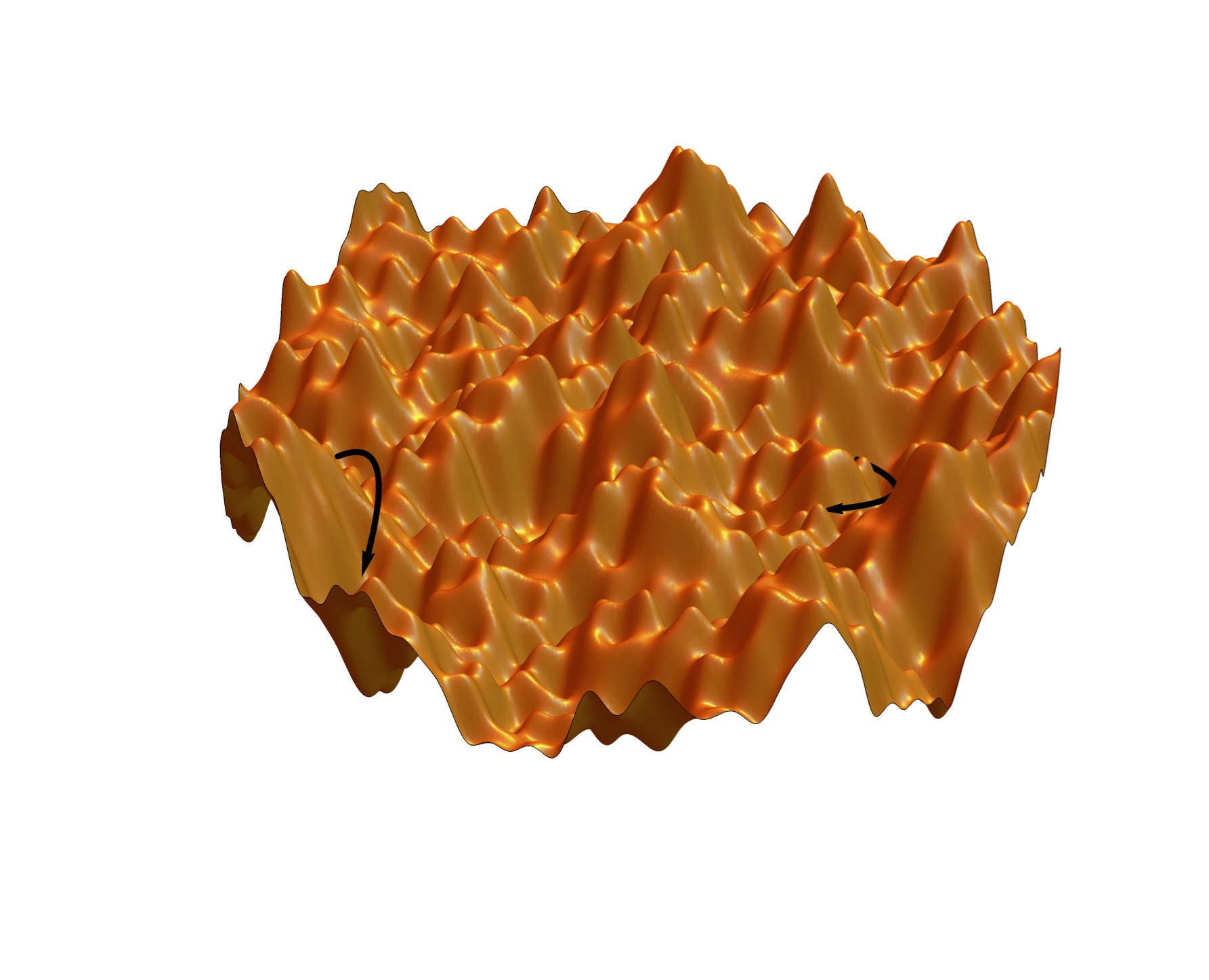 |
| Figure (credit: Chiara Cammarota, from here): A schematic rugged energy landscape with a multitude of energy minima, maxima, and saddles. Arrows denote some of the possible relaxation pathways. |
A hallmark of glasses is that they have a very broad distribution of relaxation times for structural motions, stretching out to extremely long timescales. This is a signature of the "energy landscape" for the different configurations, where there are many local minima with a huge distribution of "barrier heights". This is illustrated in the figure at right (sourced from the Simons Collaboration on Cracking the Glass Problem). Glasses have been a fascinating physics problem for decades. They highlight challenges in how to think about thermodynamic equilibrium, while having universality in many of their properties. Window glass, molecular glasses, many polymers that we encounter - all of these disparate systems are glasses.
Sunday, May 14, 2023
Anyons, simulation, and "real" systems
Quanta magazine this week published an article about two very recent papers, in which different groups performed quantum simulations of anyons, objects that do not follow Bose-Einstein or Fermi-Dirac statistics when they are exchanged. For so-called Abelian anyons (which I wrote about in the link above), the wavefunction picks up a phase factor \(\exp(i\alpha)\), where \(\alpha\) is not \(\pi\) (as is the case for Fermi-Dirac statistics), nor is it 0 or an integer multiple of \(2\pi\) (which is the case for Bose-Einstein statistics). Moreover, in both of the new papers (here and here), the scientists used quantum simulators (based on trapped ions in the former, and superconducting qubits in the latter) to create objects that act like nonAbelian anyons. For nonAbelian anyons, you shouldn't even think in terms of phase factors under exchange - the actual quantum state of the system is changed by the exchange process in a nontrivial way. That means that the system has a memory of particle exchanges, a property that has led to a lot of interest in trying to encode and manipulate information that way, called braiding, because swapping objects that "remember" their past locations is a bit like braiding yarn - the braided lengths of the yarn strands keep a record of how the yarn ends have been twisted around each other.
 |
| Hat tip to Pierre-Luc Dallaire-Demers for the meme. |
Analog simulation goes back a long way. It is possible to build electronic circuits using op-amps and basic components so that the output voltage obeys desired differential equations, effectively solving some desired problem. In some sense, the present situation is a bit like this. Using (somewhat noise, intermediate-scale) quantum computing hardware, the investigators have set up a system that obeys the math of nonAbelian anyons, and they report that they have demonstrated braiding. Assuming that the technical side holds up, this is impressive and shows that it is possible to implement some version of the math behind this idea of topologically encoding information. That is not the same, however, as showing that some many-body system's spontaneously occurring excitations obey that math, which is the key scientific question of interest to CM physicists.
(Obligatory nerdy joke: What is purple and commutes? An Abelian grape.)
Friday, May 05, 2023
Michio Kaku and science popularization in the Age of Shamelessness
In some ways, we live in a golden age of science popularization. There are fantastic publications like Quanta doing tremendous work; platforms like YouTube and podcasts have made it possible for both practicing scientists and science communicators to reach enormous audiences; and it seems that prior generations' efforts (Cosmos, A Brief History of Time, etc.) inspired whole new cohorts of people to both take up science and venture into explaining it to a general audience.
Science popularization is important - not at the same level as human rights, freedom, food, clothing, and shelter, of course, but important. I assert that we all benefit when the populace is educated, able to make informed decisions, and understands science and scientific thinking. Speaking pragmatically, modern civilization relies on a complex, interacting web of technologies, not magic. The only way to keep that going is for enough people to appreciate that and continue to develop and support the infrastructure and its science and engineering underpinnings. More philosophically, the scientific understanding of the world is one of humanity's greatest intellectual achievements. There is amazing, intricate, beautiful science behind everything around us, from the stars in the skies to the weirdness of magnets to the machinery of life, and appreciating even a little of that is good for the soul.
Michio Kaku, once a string theorist (albeit one who has not published a scientific paper in over 20 years), has achieved great fame as a science popularizer. He has written numerous popular books, increasingly with content far beyond his own actual area of expertise. He has a weekly radio show and the media love to put him on TV. For years I've been annoyed that he clearly values attention far beyond accuracy, and he speaks about the most speculative, far-out, unsupported conjectures as if they are established scientific findings. Kaku has a public platform for which many science communication folks would give an arm an a leg. He has an audience of millions.
This is why the his recent appearance on Joe Rogan's podcast is just anger-inducing. He has the privilege of a large audience and uses it by spewing completely not-even-wrong views about quantum computing (the topic of his latest book), a subject that already has a serious hype problem. An hour of real research would show him that he is wrong about nearly everything he says in that interview. Given that he's written a book about the topic, surely he has done at least a little digging around. All I can conclude is, he doesn't care about being wrong, and is choosing to do so to get exposure and sell books. I'm not naive, and I know that people do things like that, but I would hope that science popularizers would be better than this. This feels like the scientific equivalent of the kind of change in discourse highlighted in this comic.
Update: Scott Aaronson has a review of Kaku's book up. This youtube video is an appropriate analogy for his views about the book.
Sunday, April 23, 2023
Chemical potential and banana waffles
The concept of chemical potential is one that seems almost deliberately obscure to many. I’ve written about this here, and referenced this article. What you may not realize is that the chemical potential, of water in particular, plays a crucial role in why my banana waffle recipe works so well.
My waffle recipe starts with an old, peel-getting-brown banana, which I peel and put in a medium bowl with a couple of teaspoons of salt and a tablespoon of brown sugar. With just a little mashing with a fork to mix with the salt and sugar, the banana basically liquefies in a couple of minutes. That’s where the chemical potential comes in.
Chemical potential, \(\mu\), describes how particles tend to diffuse, from regions of high chemical potential (more accurately, high \(\mu/T\)) to regions of low chemical potential \((\mu/T\)). The water molecules in the cells of the banana is already at a higher chemical potential than, e.g., the water vapor in the air around the banana. That’s why if you let the banana sit around it would eventually dry out, and there is an “osmotic” pressure that pushes out against the cell membranes and cell walls. Adding salt and sugar to the exterior of the cells lowers the chemical potential for water outside the cells even more (because there is an energetic benefit to the water molecules to form a solution with the salt and sugar - the polar water molecules have an attractive interaction with the ions from the salt, and an attractive interaction via hydrogen bonding with the sugar). This increases the osmotic pressure, so that water leaks out of the cells (maybe even rupturing the cell membrane, though when people want to encourage that they throw in a little soap, not conducive to good waffles). Wait a couple of minutes, stir, and then I have yummy banana goo that forms the beginning of my Sunday morning waffle batter.
This is a goofy example of the power of thermodynamics and statistical mechanics. At room temperature, there are many more microscopic arrangements of the water molecules (in the presence of sugar and salt) with the banana forming liquefied goo than with the water sitting in the cells, and so the liquefaction happens spontaneously once the ingredients are put together. (Osmosis can even be funny - I highly recommend reading this story of you can find a copy.)
Saturday, April 15, 2023
Brief items
With the end of the semester approaching and various grant deadlines, it's been a very busy time. Here are some items I spotted this week (some new, some old):
- This article from Quanta about the "Einstein tile" is great - I particularly like the animated illustration. This prompted some fun discussions with colleagues about whether there might be materials with structures like this, and what their properties would be, since they are ordered yet aperiodic yet not quasicrystalline.
- On twitter, I saw a link to this Nature Photonics paper that measures losses in what are designed to be topological photonic structures. The motivation behind such structures is that certain propagating optical modes are expected to be topologically protected from back-scattering. Instead, the authors find plenty of back-scattering, and they raise the question of how useful topological protection is in practice. Thought-provoking.
- Also on twitter, I saw this Nature paper, which uses ultrafast optics to look at Floquet effects with sub-optical-cycle timing resolution.
- Lengthy article in Science about plagiarism and Ranga Dias.
- This article is about making a low-cost (€100) detector for electron microscopy, far cheaper than the hardware supplied by commercial SEM vendors. I reiterate: I think it would have enormous impact if someone could develop an SEM that is truly inexpensive (say less than $2000, so that many high schools and community colleges could afford one).
- I had occasion to re-read the original paper by Little and Parks (1962) on what is now called the Little-Parks effect. The transition temperature (inferred via the resistance in the transition regime) of a thin-walled superconducting cylinder oscillates with external magnetic field threading the cylinder. The oscillations are periodic in magnetic flux with a period \(h/2e\), providing key evidence that the current in superconductors is carried by pairs electrons (or holes). It's cool to see how they made a 1 micron inner-diameter Sn cylinder back before we had all the fancy modern fabrication techniques, reaffirming that GE Varnish is a wonder material.
- SpaceX is going to try to launch their truly enormous rocket this coming week from Boca Chica, TX. Like any first test flight, it has a good chance of failure, but if they can get this system to work as envisioned, it will truly be transformative in terms of payload to orbit. Here's the link to their live webcast that starts Monday morning.
Saturday, April 01, 2023
The problems and opportunities of data
We live in a world of "big data", and this presents a number of challenges for how we handle this at research universities. Until relatively recently, the domain of huge volume/huge throughput scientific data was chiefly that of the nuclear/particle physics community and then the astronomy community. The particle physicists in particular have been pioneers in how they handle enormous petabyte quantities of data at crazy high rates.
Thanks to advances in technology, though, it is now possible for small university research groups to acquire terabytes of data in an afternoon, thanks to high speed/high resolution video recording, hyperspectral imaging, many GHz bandwidths, etc. Where things get tricky is, this new volume and pace are demands that researchers, universities, funding agencies, publishers, etc. are generally not equipped to handle, in terms of data stewardship.
I've written before about the responsibilities of various people regarding data stewardship. Data from sponsored research at universities is "owned" by the universities, because they are held responsible by the funding agencies (e.g. NSF, DOE, DOD) for, among other things, maintaining accessible copies until years after the end of the funding agreements. The enormous volumes of data that can now be generated are problematic. With the exception of a small number of universities that host supercomputing centers, most academic institutions just do not have the enterprise-class storage capacity (either locally or contracted via cloud storage services) to meet the ever-growing demand. Ordering a bunch of 8 TB external hard drives and keeping them in a growing stack on your shelves is not a scalable, sustainable plan. Universities all over are finding out that providers can't really provide "unlimited" capacity without passing costs along to the research institutions. Agencies are also often not fans of significant budgeting in proposals for long-term data retention. It's not clear that anyone has a long-term solution to this that really meets everyone's needs. Repositories like zenodo are great, but somewhere someone actually has to pay the costs to operate these.
Further, there is a thriving movement toward open science (with data sharing) and FAIR data principles - making sure that data is findable, accessible, interoperable, and resuseable. In condensed matter physics, this is exemplified by the Materials Genome Initiative and its updated strategic plan. There is a belief that having this enormous amount of information available (and properly indexed with metadata so that it can be analyzed and used intelligently), combined with machine learning and AI, will lead to accelerated progress in research, design, and discoveries.
At the same time, in the US there are increasing concerns about data security, and coming regulatory actions about this. University research administrators are looking very hard at all this, as is the Council on Government Relations, both because of chilling effects across the community and to push to make sure that Congress and agencies don't saddle universities with mutually incompatible and contradictory policies and requirements.
Meeting all of these needs is going to be a challenge for a long time to come. If any readers have particular examples of how to meet the needs of very large volume data retention, I'd appreciate the comments.
Subscribe to:
Posts (Atom)