A blog about condensed matter and nanoscale physics. Why should high energy and astro folks have all the fun?
Search This Blog
Thursday, July 27, 2023
Condensed matter on the public stage, and not in a good way
Sunday, July 23, 2023
Disorganized thoughts on "Oppenheimer"
I saw "Oppenheimer" today. Spoiler warning, I suppose, though I think we all know how this story ends. Just in case you were wondering, there is no post-credit scene to set up the sequel. (For the humor-impaired: that was a joke.)
The movie was an excellent piece of film-making, and I hope it's an opportunity for a large viewing audience to learn about a reasonable approximation of incredibly consequential history. Sure, I can nitpick about historical details (why did Nolan leave out "Now we are all sons of bitches", transfer a bet to a different person, and omit Fermi dropping bits of paper to estimate the yield of the Trinity test? Why did he show Vannevar Bush seemingly hanging out at Los Alamos? Update: rereading The Making of the Atomic Bomb, I was surprised to learn that Bush apparently was, in fact, present at the Trinity test! Also, I do now see on an updated cast list that Kistiakowsky was portrayed in the movie, so I may have been wrong about the bet as well. Mea culpa.). Still, the main points come through - the atmosphere of war-time Los Alamos, and the moral complexity and ambiguity of Oppenheimer and the bomb.
The definitive work about the Manhattan Project is The Making of the Atomic Bomb by Richard Rhodes. That book truly captures the feeling of the era and the project. Rereading it now, it still amazes how physicists and chemists of the time were able to make astonishing progress. Reading about how Fermi & co. discovered moderation of neutrons (that is, slowing of neutrons through inelastic scattering off of hydrogen-containing materials like paraffin) is just mind-blowing as an experimentalist. (They stumbled upon this by realizing that they got different experimental results if they ran their measurements on wood tables rather than marble tables within the same lab.)
I saw someone lamenting on twitter that this movie was unlikely to inspire a generation of young people to go into physics. Clearly that was not the intent of the film at all. I think it's a net positive if people come away from the movie with a sense of the history and the fact that individual personalities have enormous sway even in the face of huge historical events. Many people in the story are physicists, but the point is that they're complicated people dealing with the morality of enormously consequential decisions (on top of the usual human frailties). (One thing the movie gets right is Teller's relentless interest in "the super" and his challenges in working with others on the Manhattan Project. If Teller had been a less challenging personality, the course of nuclear weapons development may have been very different. It reminds me superficially of William Shockley, whose managerial skills or lack thereof directly led to the creation of Silicon Valley.)
For those interested in reading more about the context of the Manhattan Project, I recommend a couple of items. The Los Alamos Primer are the notes that were given to incoming Project members and make for fascinating reading, accessible at the advanced undergrad level. The Farm Hall transcripts are the transcribed recordings of interned German scientists held by the British in August, 1945. They go from denial (the Americans couldn't possibly have developed a bomb) to damage control (clearly we slow-walked everything because we didn't really want the Nazis to get nuclear weapons) in the space of a couple of days.
Sunday, July 16, 2023
What are "quantum oscillations"?
![]() |
| An electron with wavevector \(\mathbf{k}\) in a magnetic field \(\mathbf{B}\) will trace out an orbit (yellow) in \(\mathbf{k}\)-space. |
![]() |
| Fermi surface of Cu. If a magnetic field is directed as shown, there are two orbits (purple) that will contribute oscillations in resistivity and magnetization. |
Saturday, July 01, 2023
Molecular electronics in 2023
This past week I was fortunate to attend this meeting, the most recent in an every-few-years series that brings together a group of researchers interested in electronic transport in molecular systems. This brings together physicists and chemists, and this was the first one I've attended since this one in 2015.
The evolution of the field over the years has been very interesting. Generally gone are the discussions of using actual chemically synthesized molecules as electronic devices in eventual ultrascaled computing applications. Rather, there is a broad recognition that these systems are important testbeds for our understanding of physics that can have broad ramifications for understanding chemical processes (e.g. quantum interference in molecules leading to sharply energy dependent electronic transmission and therefore enhanced thermoelectric effects - more here), light emission (e.g. the role of local vibrations, Franck-Condon effects, and quantum interference in determining the lineshape of light from a single molecule), and the right ways to think about dissipation and the flow of energy at the extreme nanoscale in open, driven quantum systems. In terms of the underlying physics, the processes at work in molecular devices are the same ones relevant in eventual single-nm CMOS electronic devices.
There were two particular lingering problems/mysteries discussed at the workshop that might be of particular broad interest.
- Current-induced spin selectivity (CISS) remains an intriguing and confusing set of phenomena. The broad observation, advanced initially by the group of Prof. Ron Naaman, is that in several different experimental implementations, is that chiral molecules seem to couple nontrivially to electron spin - e.g., photoemission through chiral molecules can generate spin-polarized electrons, with the handedness of the chiral molecule and the direction of electron motion picking out a preferred spin orientation. This has led to a diverse array of experiments (reviewed here) and proposed theoretical explanations (reviewed here). CISS has been used, e.g., to get LEDs to emit circularly polarized light by spin-polarizing injected carriers. The situation is very complicated, though, and while some kind of spin-orbit coupling must be at work, getting good agreement from theory calculations has proven challenging. Recent measurements in chiral solids (not molecules) look comparatively clean to me (see here and here), bringing device design and spin Hall-based detection into play.
- Charge transport over through thick films of biomolecules remains surprising and mysterious. In single-molecule experiments, when there are no molecular levels resonant with the electrons of the source and drain electrodes, conduction of electrons is through off-resonant tunneling. As tunneling is exponentially suppressed with distance, this implies that the conductance \(G \sim \exp(-\beta L)\), where \(L\) is the length of the molecule, and \(\beta\) is a parameter that describes how quickly conduction falls off, and is typically on the order of 0.5 inverse Angstroms. For longer molecules or thick films of molecules, conduction typically takes place through some flavor of thermally-activated hopping and is steeply suppressed as temperature is lowered. In surprising contrast to this, thick (30-50 nm) films of some biomolecules show almost temperature-independent conduction from room temperature down to cryogenic temperatures. This is really surprising!
Saturday, June 24, 2023
A busy and contentious week in condensed matter physics
There were a couple of interesting and controversial things afoot this week in the condensed matter world.
- There was a new preprint from the group of Prof. Hemley at the University of Illinois Chicago featuring electronic transport measurements in samples of the putative room temperature superconductor made from Lu-N-H, samples synthesized by the group of Ranga Dias. This was mentioned as a potential confirmation of the room temperature superconductivity result by the New York Times. Plotting the full raw data that goes with the new preprint, however, certainly gives many people (including me) pause. The raw resistance vs temperature sweep traces have unphysically narrow (in temperature) drops to and rises from zero, as shown. Obviously I don't know with complete certainty, but this looks exactly like what would be seen if one of the contacts was bad. Time will tell, but the raw data surely look like a flaky contact rather than some weird re-entrant and thermally hysteretic superconductivity.
- Meanwhile, Physical Review did something quite unusual, as they explain in this editorial that ran in Phys Rev B. They allowed the Microsoft Quantum group to publish their latest report about looking for Majorana fermions in superconductor/semiconductor hybrid structures, without giving readers all of the necessary parameters and information necessary for reproducing the work. The rationale is that the community is better served by getting this result into the peer-reviewed literature now even if all of the details aren't going to be made available publicly until the end of 2024. I don't get why the researchers didn't just wait to publish, if they are so worried about those details being available. There has been enough controversy about data availability in the Majorana arena that I don't understand why anyone would invite more discussion about transparency on this. Meanwhile, another group reports related phenomenology, though they argue that due to disorder they are not seeing Majoranas in their devices. A review about the experimental hunt for Majoranas in condensed matter systems also came out this week in Science.
Monday, June 19, 2023
Food and (broadly speaking) fluid mechanics - great paper!
I know I'm a particular niche demographic, in that I'm a scientist who likes cooking and actually had mech-e training in fluid mechanics, but trust me: this article is just excellent, touching on a ton of interesting phenomena that you can play with in your own kitchen, while making connections to cutting-edge ongoing research.
Update: APS Physics has a Q&A with the first author here.
Thursday, June 15, 2023
Some recent papers of interest
- This paper in Nature, a collaboration between folks at Ohio University and Argonne, is a neat combination of scanning tunneling microscopy and (synchrotron-enabled) resonant x-ray absorption. The authors bring an STM tip (an extremely sharp metal tip) down to within a nm of the sample surface, so that electrons can tunnel quantum mechanically from the sample to the tip. Then bang the sample with x-rays that are resonant with core levels of particular atoms in the sample. In this case, one sample consisted of iron-containing molecules. The x-rays could kick electrons out of the iron atoms where they are then detected by the tip, allowing atomic-resolution mapping of the desired atoms. (It's a bit more subtle than that - see Fig. 2j - but that's basically the gist.)
- This paper in Science is also very cool (arxiv version here). People are generally used to the idea that photons are quantum objects. Indeed, photons are often discussed when talking about standard examples of quantum "weirdness". A 50/50 beam splitter can put a photon in a superposition of going down two different paths, for example. There is a whole approach to quantum information processing based on these properties. This new paper demonstrates a beam splitter for individual phonons, specifically surface acoustic waves. This opens the possibility of a solid-state phonon-based version of that approach to quantum computing. Very neat.
- Lastly for now, this paper in Nature Materials (arxiv version here) uses STM to look at how superconductivity goes away in a cuprate superconductor as the doping level is increased way beyond the level that optimizes superconductivity. The decrease in transition temperature and superfluid density with increasing doping has been a mystery. This paper shows that the system breaks up into superconducting puddles surrounded by metallic regions, and that instead of the superconducting energy gap closing (implying a weakening of the interaction that pairs up the electrons), it "fills in". Lots to ponder.
Thursday, June 08, 2023
ARPA-E Roadshow
- "Hardware is hard." - said by Rita Hansen, quoting a timeworn truth when talking about the challenge of actually building and deploying pathbreaking gadgets in the field.
- "Work for ARPA-E, and you get to design emojis!" - Halle Cheeseman, poking fun at the fact that every project has its own little icon-like logo.
- Carlos Araque of Quaise Energy was part of a panel and spoke about their plans to use enormously powerful microwave sources to drill holes 20 km deep, so that one can have ubiquitous geothermal energy. (I'll admit, cool as this sounds, I just don't understand how they plan to get vaporized rock out of a many-km-deep bore hole.)
- Joe Zhou of Quidnet Energy was also on the panel (with Araque and Hansen) and spoke about their plan for underground fracking-type pumping to use compressed water for energy storage for solar/wind/etc. It's more geographically portable than pumping water up a nearby mountain for energy storage, but sounds like it could have some nontrivial challenges.
- Hinetics plans to have an integrated cryocooler in their motors, so that they can use high-Tc superconducting wiring without the need for separate refrigeration or cryogens. Sounds very clever.
- Veir has plans for compact, evaporative LN2 cooling of high-Tc transmission lines. This would allow very high current transmission at low voltages, so that utilities could avoid the giant, ugly towers and use a lot less land/narrower rights-of-way.
- Brimstone is making net-carbon-negative cement based on calcium silicate (instead of traditional calcium carbonate which liberates CO2 when it sets). This seems like potentially a huge deal if it scales, since concrete accounts for 8% of global CO2 emissions annually.
Thursday, June 01, 2023
What is a spin glass?
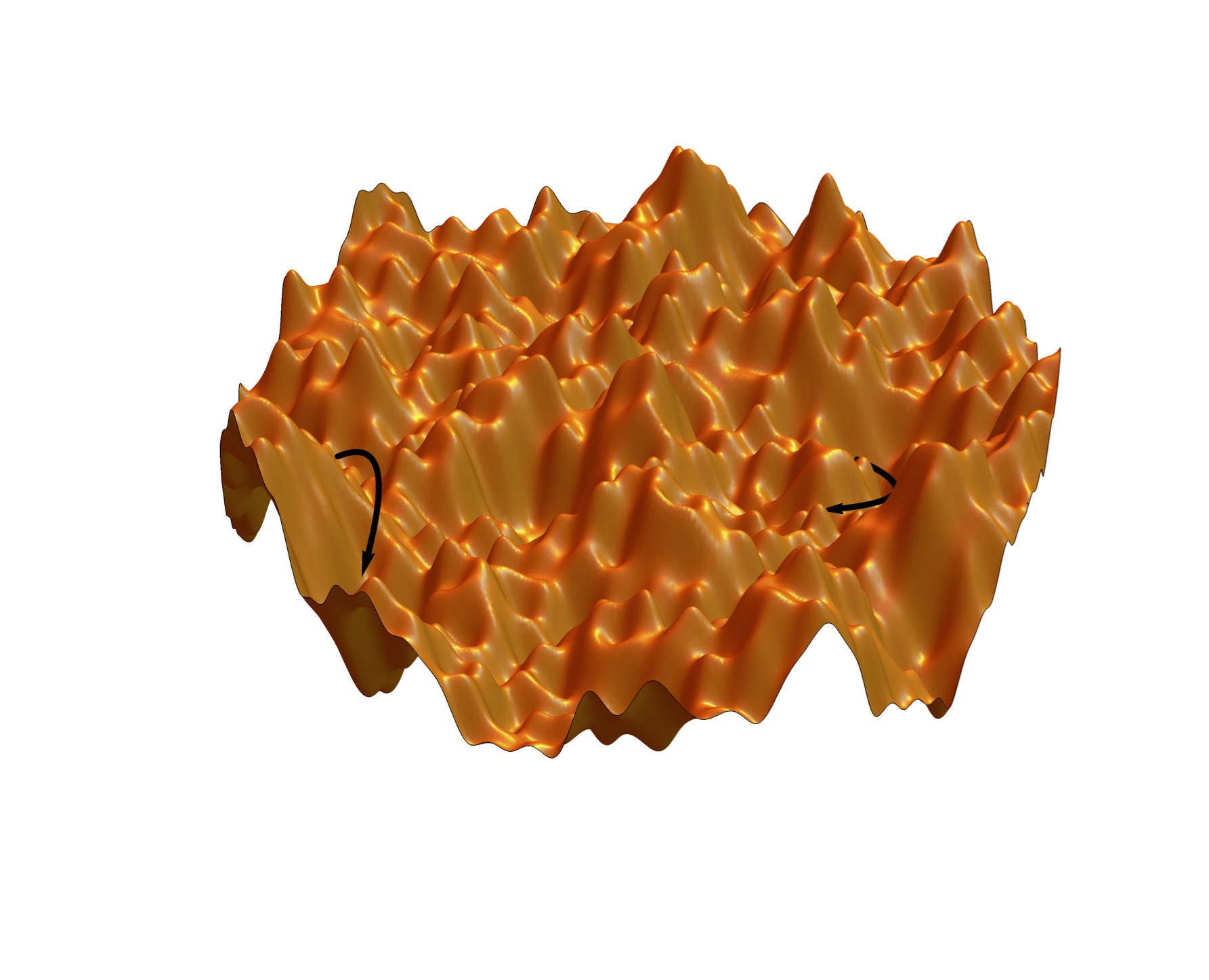
As mentioned previously, structural glasses are materials in which there is no periodic lattice (no long-range spatial order) and the building blocks get "stuck" in some configuration, kinetically unable to get to the true energetic minimum state which would almost certainly be a periodic crystal. Upon cooling from the liquid state, their viscosity increases by many orders of magnitude (in various ways) until they act like rigid solids. Distinguishing "glassy" physics includes strongly interacting building blocks, a complicated energy landscape with many local minima, spatial disorder leading to hugely varying interaction strengths and a very broad distribution of relaxation times (so that responses to perturbations aren't simple exponentials in time, but are more slowly decaying functions such as \(-\log t\)). These slow relaxations are called "aging", and when the system is perturbed (e.g., a sudden stress is applied, or a sudden temperature change is applied and removed), the system's response picks back up ("rejuvenation") before aging again.
Analogs of all of these properties are also seen in spin glasses, which I wrote about a bit in this post about the 2021 Nobel in Physics. In a spin glass, the degrees of freedom aren't atoms or groups of atoms, but instead are the magnetic moments of particular atoms, such as isolated Fe atoms in a Cu bulk. The analog of the periodic crystal would be some version of long-range magnetic order. In a typical spin glass, the magnetic atoms are positioned randomly in a non-magnetic host, so that the magnetic interactions between neighbors are strong, but often random in sign and strength due to disorder. As a result, the magnetic system has a complicated energy landscape with many minima (corresponding to configurations with similar energies but it would cost significant energy to rearrange the spins to get from one local energy minimum configuration to another). These systems show aging, rejuvenation, etc.
The universality of glassy dynamics across such microscopically different systems is one of those remarkable emergences that crops up in condensed matter. Despite the very different microscopic physics, there is some deeper organizing principle at work that leads to these properties.
Spin glasses have attracted quite a bit of interest for a couple of reasons. First, they are comparatively easy to study, since magnetic properties and their time evolution are usually easier to measure than detailed microscopic structural arrangements in structural glasses. Second, it is possible to create models of spin glasses in a variety of systems, including using qubits. Spin glasses can also be mapped to certain kinds of optimization problems (see this pdf news article).
Interestingly, a recent paper in Nature (arxiv version) by folks at D-Wave has used their 5000 qubit gadget to do a quantum simulation of a spin glass. They can program the interactions among the qubits and make them random and frustrated as in a spin glass. In small test configurations, they show that they can see (at short times, anyway) quantum coherent dynamics that agree with calculations. They can then look at much larger systems, well beyond traditional calculational practicality, and see what happens. I don't know enough about the system to evaluate this critically, but it looks like a very nice platform. (They’ve come along way from when their founder used to argue and insult in blog comments. They now show as anonymous, but the one from Geordie Rose is clear from context.)
Sunday, May 21, 2023
What is a glass?
![]() |
| Figure (credit: Chiara Cammarota, from here): A schematic rugged energy landscape with a multitude of energy minima, maxima, and saddles. Arrows denote some of the possible relaxation pathways. |
Sunday, May 14, 2023
Anyons, simulation, and "real" systems
Quanta magazine this week published an article about two very recent papers, in which different groups performed quantum simulations of anyons, objects that do not follow Bose-Einstein or Fermi-Dirac statistics when they are exchanged. For so-called Abelian anyons (which I wrote about in the link above), the wavefunction picks up a phase factor \(\exp(i\alpha)\), where \(\alpha\) is not \(\pi\) (as is the case for Fermi-Dirac statistics), nor is it 0 or an integer multiple of \(2\pi\) (which is the case for Bose-Einstein statistics). Moreover, in both of the new papers (here and here), the scientists used quantum simulators (based on trapped ions in the former, and superconducting qubits in the latter) to create objects that act like nonAbelian anyons. For nonAbelian anyons, you shouldn't even think in terms of phase factors under exchange - the actual quantum state of the system is changed by the exchange process in a nontrivial way. That means that the system has a memory of particle exchanges, a property that has led to a lot of interest in trying to encode and manipulate information that way, called braiding, because swapping objects that "remember" their past locations is a bit like braiding yarn - the braided lengths of the yarn strands keep a record of how the yarn ends have been twisted around each other.
![]() |
| Hat tip to Pierre-Luc Dallaire-Demers for the meme. |
Analog simulation goes back a long way. It is possible to build electronic circuits using op-amps and basic components so that the output voltage obeys desired differential equations, effectively solving some desired problem. In some sense, the present situation is a bit like this. Using (somewhat noise, intermediate-scale) quantum computing hardware, the investigators have set up a system that obeys the math of nonAbelian anyons, and they report that they have demonstrated braiding. Assuming that the technical side holds up, this is impressive and shows that it is possible to implement some version of the math behind this idea of topologically encoding information. That is not the same, however, as showing that some many-body system's spontaneously occurring excitations obey that math, which is the key scientific question of interest to CM physicists.
(Obligatory nerdy joke: What is purple and commutes? An Abelian grape.)
Friday, May 05, 2023
Michio Kaku and science popularization in the Age of Shamelessness
In some ways, we live in a golden age of science popularization. There are fantastic publications like Quanta doing tremendous work; platforms like YouTube and podcasts have made it possible for both practicing scientists and science communicators to reach enormous audiences; and it seems that prior generations' efforts (Cosmos, A Brief History of Time, etc.) inspired whole new cohorts of people to both take up science and venture into explaining it to a general audience.
Science popularization is important - not at the same level as human rights, freedom, food, clothing, and shelter, of course, but important. I assert that we all benefit when the populace is educated, able to make informed decisions, and understands science and scientific thinking. Speaking pragmatically, modern civilization relies on a complex, interacting web of technologies, not magic. The only way to keep that going is for enough people to appreciate that and continue to develop and support the infrastructure and its science and engineering underpinnings. More philosophically, the scientific understanding of the world is one of humanity's greatest intellectual achievements. There is amazing, intricate, beautiful science behind everything around us, from the stars in the skies to the weirdness of magnets to the machinery of life, and appreciating even a little of that is good for the soul.
Michio Kaku, once a string theorist (albeit one who has not published a scientific paper in over 20 years), has achieved great fame as a science popularizer. He has written numerous popular books, increasingly with content far beyond his own actual area of expertise. He has a weekly radio show and the media love to put him on TV. For years I've been annoyed that he clearly values attention far beyond accuracy, and he speaks about the most speculative, far-out, unsupported conjectures as if they are established scientific findings. Kaku has a public platform for which many science communication folks would give an arm an a leg. He has an audience of millions.
This is why the his recent appearance on Joe Rogan's podcast is just anger-inducing. He has the privilege of a large audience and uses it by spewing completely not-even-wrong views about quantum computing (the topic of his latest book), a subject that already has a serious hype problem. An hour of real research would show him that he is wrong about nearly everything he says in that interview. Given that he's written a book about the topic, surely he has done at least a little digging around. All I can conclude is, he doesn't care about being wrong, and is choosing to do so to get exposure and sell books. I'm not naive, and I know that people do things like that, but I would hope that science popularizers would be better than this. This feels like the scientific equivalent of the kind of change in discourse highlighted in this comic.
Update: Scott Aaronson has a review of Kaku's book up. This youtube video is an appropriate analogy for his views about the book.
Sunday, April 23, 2023
Chemical potential and banana waffles
The concept of chemical potential is one that seems almost deliberately obscure to many. I’ve written about this here, and referenced this article. What you may not realize is that the chemical potential, of water in particular, plays a crucial role in why my banana waffle recipe works so well.
My waffle recipe starts with an old, peel-getting-brown banana, which I peel and put in a medium bowl with a couple of teaspoons of salt and a tablespoon of brown sugar. With just a little mashing with a fork to mix with the salt and sugar, the banana basically liquefies in a couple of minutes. That’s where the chemical potential comes in.
Chemical potential, \(\mu\), describes how particles tend to diffuse, from regions of high chemical potential (more accurately, high \(\mu/T\)) to regions of low chemical potential \((\mu/T\)). The water molecules in the cells of the banana is already at a higher chemical potential than, e.g., the water vapor in the air around the banana. That’s why if you let the banana sit around it would eventually dry out, and there is an “osmotic” pressure that pushes out against the cell membranes and cell walls. Adding salt and sugar to the exterior of the cells lowers the chemical potential for water outside the cells even more (because there is an energetic benefit to the water molecules to form a solution with the salt and sugar - the polar water molecules have an attractive interaction with the ions from the salt, and an attractive interaction via hydrogen bonding with the sugar). This increases the osmotic pressure, so that water leaks out of the cells (maybe even rupturing the cell membrane, though when people want to encourage that they throw in a little soap, not conducive to good waffles). Wait a couple of minutes, stir, and then I have yummy banana goo that forms the beginning of my Sunday morning waffle batter.
This is a goofy example of the power of thermodynamics and statistical mechanics. At room temperature, there are many more microscopic arrangements of the water molecules (in the presence of sugar and salt) with the banana forming liquefied goo than with the water sitting in the cells, and so the liquefaction happens spontaneously once the ingredients are put together. (Osmosis can even be funny - I highly recommend reading this story of you can find a copy.)
Saturday, April 15, 2023
Brief items
With the end of the semester approaching and various grant deadlines, it's been a very busy time. Here are some items I spotted this week (some new, some old):
- This article from Quanta about the "Einstein tile" is great - I particularly like the animated illustration. This prompted some fun discussions with colleagues about whether there might be materials with structures like this, and what their properties would be, since they are ordered yet aperiodic yet not quasicrystalline.
- On twitter, I saw a link to this Nature Photonics paper that measures losses in what are designed to be topological photonic structures. The motivation behind such structures is that certain propagating optical modes are expected to be topologically protected from back-scattering. Instead, the authors find plenty of back-scattering, and they raise the question of how useful topological protection is in practice. Thought-provoking.
- Also on twitter, I saw this Nature paper, which uses ultrafast optics to look at Floquet effects with sub-optical-cycle timing resolution.
- Lengthy article in Science about plagiarism and Ranga Dias.
- This article is about making a low-cost (€100) detector for electron microscopy, far cheaper than the hardware supplied by commercial SEM vendors. I reiterate: I think it would have enormous impact if someone could develop an SEM that is truly inexpensive (say less than $2000, so that many high schools and community colleges could afford one).
- I had occasion to re-read the original paper by Little and Parks (1962) on what is now called the Little-Parks effect. The transition temperature (inferred via the resistance in the transition regime) of a thin-walled superconducting cylinder oscillates with external magnetic field threading the cylinder. The oscillations are periodic in magnetic flux with a period \(h/2e\), providing key evidence that the current in superconductors is carried by pairs electrons (or holes). It's cool to see how they made a 1 micron inner-diameter Sn cylinder back before we had all the fancy modern fabrication techniques, reaffirming that GE Varnish is a wonder material.
- SpaceX is going to try to launch their truly enormous rocket this coming week from Boca Chica, TX. Like any first test flight, it has a good chance of failure, but if they can get this system to work as envisioned, it will truly be transformative in terms of payload to orbit. Here's the link to their live webcast that starts Monday morning.
Saturday, April 01, 2023
The problems and opportunities of data
We live in a world of "big data", and this presents a number of challenges for how we handle this at research universities. Until relatively recently, the domain of huge volume/huge throughput scientific data was chiefly that of the nuclear/particle physics community and then the astronomy community. The particle physicists in particular have been pioneers in how they handle enormous petabyte quantities of data at crazy high rates.
Thanks to advances in technology, though, it is now possible for small university research groups to acquire terabytes of data in an afternoon, thanks to high speed/high resolution video recording, hyperspectral imaging, many GHz bandwidths, etc. Where things get tricky is, this new volume and pace are demands that researchers, universities, funding agencies, publishers, etc. are generally not equipped to handle, in terms of data stewardship.
I've written before about the responsibilities of various people regarding data stewardship. Data from sponsored research at universities is "owned" by the universities, because they are held responsible by the funding agencies (e.g. NSF, DOE, DOD) for, among other things, maintaining accessible copies until years after the end of the funding agreements. The enormous volumes of data that can now be generated are problematic. With the exception of a small number of universities that host supercomputing centers, most academic institutions just do not have the enterprise-class storage capacity (either locally or contracted via cloud storage services) to meet the ever-growing demand. Ordering a bunch of 8 TB external hard drives and keeping them in a growing stack on your shelves is not a scalable, sustainable plan. Universities all over are finding out that providers can't really provide "unlimited" capacity without passing costs along to the research institutions. Agencies are also often not fans of significant budgeting in proposals for long-term data retention. It's not clear that anyone has a long-term solution to this that really meets everyone's needs. Repositories like zenodo are great, but somewhere someone actually has to pay the costs to operate these.
Further, there is a thriving movement toward open science (with data sharing) and FAIR data principles - making sure that data is findable, accessible, interoperable, and resuseable. In condensed matter physics, this is exemplified by the Materials Genome Initiative and its updated strategic plan. There is a belief that having this enormous amount of information available (and properly indexed with metadata so that it can be analyzed and used intelligently), combined with machine learning and AI, will lead to accelerated progress in research, design, and discoveries.
At the same time, in the US there are increasing concerns about data security, and coming regulatory actions about this. University research administrators are looking very hard at all this, as is the Council on Government Relations, both because of chilling effects across the community and to push to make sure that Congress and agencies don't saddle universities with mutually incompatible and contradictory policies and requirements.
Meeting all of these needs is going to be a challenge for a long time to come. If any readers have particular examples of how to meet the needs of very large volume data retention, I'd appreciate the comments.
Tuesday, March 21, 2023
What do we want in a conference venue?
The APS March Meeting was in Las Vegas this year, and I have yet to talk to a single attendee who liked that decision in hindsight. In brief, the conference venue seemed about 10% too small (severe crowding issues in hallways between sessions); while the APS deal on hotels was pretty good, they should have prominently warned people that not using the APS housing portal means you fall prey to Las Vegas’s marketing schtick of quoting a low room rate but hiding large “resort fees”; with the exception of In N Out Burger, the food was very overpriced (e.g. $12 for a coffee and a muffin in the Starbucks in my hotel); and indoor spaces in town generally smelled like stale cigarettes, ineffective carpet cleaner, and desperation.
I don’t think it’s that hard to enumerate what most people would like out of a conference venue, if we are intending to have in-person meetings and are going to spend grant money and valuable time to attend the meeting with our groups. (I’m taking as a given that the March meeting is large - now up to 12K attendees, for good or ill - and I know that’s so big that some people will decide that it’s too unwieldy to be worth going. Likewise, I know that the logistics are always difficult in terms of the abstract sorting and trying to make sure that likely-popular sessions get higher capacity rooms.)
Off the top of my head, I would like:
- A meeting venue that can accommodate everyone without feeling dangerously crowded at high volume transit times between sessions, with a good selection of hotels nearby that don’t have crazy room rates. (I know that the meeting growth already likely rules out a lot of places that have hosted the March meeting in the past.)
- A high density of relatively cheap restaurants, including sandwich places, close to the venue for lunch, so that a quick bite is possible without hiking a mile or being forced to spend $20 on convention center food.
- Actual places to sit (tables and chairs) to talk with fellow attendees. Las Vegas had a much smaller number of these (indoors) than previous locations.
- Reasonable availability of water (much better these days than in the past) and not-outrageously-priced coffee and tea.
- Wifi that actually can accommodate the number of attendees; at some point in Las Vegas I basically gave up on the conference wifi and tethered to my phone. Remember, many of us still have to get some level of work done (like submitting annoyingly timed proposals) while at these.
- Modern levels of accommodations for nursing mothers, childcare, facilities for those with disabilities or mobility issues, etc.
Thursday, March 16, 2023
Recent RT superconductivity claim - summary page
- Dias's contributed talk at the APS meeting is here on youtube.
- Here is the promotional video put out by Rochester as part of the media release. It odd to me that the department chair and the dean of the PI are both in this video.
- Here is the pubpeer page that has sprung up with people reporting concerns about the paper.
- The comments attached to the paper itself contain interesting discussion (though strangely an informed comment from Julia Deitz about the EDX data was repeatedly deleted as "spam")
- There was a lot of media coverage of this paper. The Wall Street Journal was comparatively positive. The New York Times was more nuanced. Quanta had a thorough article with a witty headline describing the controversy surrounding the claim. The APS had an initial brief news report and a more extensive article emphasizing the concerns about the paper.
- Experimental preprints have appeared looking at this. The first observes a color change under pressure in LuH2, but no superconductivity in that related compound. The second is a direct replication attempt, finding x-ray structural data matching the report but no superconductivity in that material up to higher pressures and down to 10 K. Note that another preprint appeared last week reporting superconductivity at about 71 K in a different lutetium hydride at much higher pressures.
- A relevant and insightful talk from James Hamlin is here, from a recent online workshop about reproducibility in condensed matter physics. Note that (as reported in this twitter thread) significant portions of Hamlin's doctoral thesis appear verbatim in Dias' thesis.
Friday, March 10, 2023
APS March Meeting 2023, Day 4 + wrapup
My last day at the March Meeting was a bit scattershot, but here are a few highlights:
- In a session about spin transport, the opening invited talk by Jiaming He was a clear discussion of recent experimental results on spin Seebeck effects in the magnetic insulator LuFeO3. The system is quite complicated because the net magnetization direction depends nontrivially on the external field, leading to spin transport signatures with a complicated field orientation relationship.
- There was an invited session about 2D magnets, and Roland Kawakami gave a clear, pedagogical talk about how they have learned to grow epitaxially nice structures between van der Waals magnets (like Fe3GeTe2) and topological insulators (Bi2Te3). This was followed by a tag-team talk by Vishakha Gupta and Thow Min Cham from Cornell, presenting some great results about spin orbit torque measurements coupling topological insulators and van der Waals magnets, where a gate can be used to dial around the chemical potential in the TI, leading to changes in the anomalous Hall effect.
- I did check out the history of science session, featuring a very nice talk about the 75th anniversary of the foundations of quantum electrodynamics by Chad Orzel, including a book recommendation that I need to follow up on.
Thursday, March 09, 2023
APS March Meeting 2023, Day 3
There is vigorous discussion taking place on the Day 2 link regarding the highly controversial claim of room temperature superconductivity.
Highlights from Wednesday are a hodgepodge because of my meanderings:
- The session about quantum computing hardware was well attended, though I couldn't stay for the whole thing. The talk by Christopher Eichler about the status of superconducting qubit capabilities was interesting, arguing the case that SC devices can credibly get to the thresholds needed for error correction, though that will require improvements in just about every facet to get there with manageable overhead. The presentation by Anausa Chatterjee about the status of silicon spin qubits was similarly broad. The silicon implementation faces major challenges of layout, exacerbated (ironically) by the small size of the physical dots. There have been some recent advances in fab that are quite impressive, like this 4 by 4 crossbar.
- Speaking of impressive capabilities, there were two talks (1, 2) by members of the Yacoby group at Harvard about using a scanning NV center to image the formation and positions of vortices in planar Josephson junctions. They can toggle between 0 and 1 vortices in the junction and can see some screening effects that you can't just get from the transport data. Pretty images.
- Switching gears, I heard a couple of talks in an invited session about emergent phenomena in strongly correlated materials. From Paul Goddard at Warwick I learned about charge transport in some pyrochlore iridates that I didn't realize had so much residual conduction at low temperatures. See here. Likewise, James Analytis gave a characteristically clear talk about interesting superconductivity in Ni(x)Ta4Se8 (arxiv version here), an intercalated dichalcogenide that has magnetism as well as re-entrant superconductivity up at the magnetic field that kills the magnetically ordered state.
- Later in the day, there was a really interesting session about measuring entropy, which is notoriously difficult to do. As I've told students for years, you can't go to Keysight and buy an entropy-meter. There was some extremely pretty data presented by Shahal Ilani using a variant of their new scanning probe technique.
Tuesday, March 07, 2023
APS March Meeting 2023, Day 2
I ended up spending more time catching up with people this afternoon than going to talks after my session ended, but here are a couple of highlights:
- There was an invited session about the metal halide perovskites, and there were some interesting talks. My faculty colleague Aditya Mohite gave a nice presentation about the really surprising effects that light exposure has on the lattice structure of these materials. One specific example: under illumination, some of the 2D perovskite materials contract considerably, as has been seen by doing in situ x-ray diffraction on these structures. This contraction leads to a readily measured increase in electron mobility and solar cell performance. Moreover, the diffraction patterns show that some diffraction spots actually grow and get sharper under illumination. This kind of improved ordering shows that this is not just some sort of weird heating effect.
- In a session about imaging, I caught an excellent talk by Masaru Kuno, who described his spectroscopic infrared photothermal heterodyne imaging. The idea is elegant, if you have access to the right light source. Use a tunable mid-IR laser that can go across the "fingerprint region" of photon energies to illuminate the sample in a time-modulated way. If there is an absorptive mode (vibrational in a molecule, or plasmonic in a metal) there, the heating will cause a time-modulated change in the local index of refraction, which is then detected using a visible probe beam and a lock-in amplifier. It was an extremely clear, pedagogical talk.
- I spent much of my time in the strange metal session where I spoke. There were some very good (though rather technical) theory talks, trying to understand the origins of strange metallicity and key issues like the role of disorder.
APS March Meeting 2023, Day 1
Ahh, Las Vegas. I will say, I think every APS March Meeting from now on should have a giant Ferris wheel right by the registration lobby.
Here are a few highlights from what I saw after I arrived around lunchtime today:
- Given some of my current research, I spent a fair bit of time at the invited session about strange metals today. All of the talks that I saw were very strong. Andrew MacKenzie spoke about recent measurements of the Lorenz number in such materials (particularly Sr3Ru2O7) and made a persuasive case that strange metals do look different in their temperature-dependent thermal conductivity, because of very strong electron-electron scattering. This is discussed in this recent review article.
- In the same session, Brad Ramshaw showed very pretty angle-dependent magnetoresistance data on Nd-LSCO, an archetypal cuprate, arguing that the whole data set can be modeled very well assuming conventional quasiparticles and Boltzmann equation analysis (albeit with a funky combination of temperature-independent anisotropic scattering and strongly temperature dependent isotropic scattering). His postdoc Gaël Grissonnanche expanded on this and looked at how such a model can also reproduce the linear-in-B magnetoresistance in this system.
- At the McGroddy Prize session, James Hone gave a very nice overview of the impressive body of work from Columbia over the years on all of the stackable van der Waals materials. Some particular recent highlights included: (1) using deliberately oxidized WSe2 (into WOx) as a low-disorder, very high workfunction material that modulation dopes holes when stacked on a target layer of interest; (2) Using vdW material ferroelectricity to modulate superconductivity in MoTe2; in-progress work using an AFM + an hBN "handle" to bend a graphene "noodle" to get continuously tuned, clean moiré potentials; and electrostatically actuated sliding motion of monolayer vdW material.
Sunday, March 05, 2023
APS March Meeting 2023 - coming soon
I will be attending the 2023 APS March Meeting in Las Vegas this week. I will do my best to try to report on some highlights daily, though that may be more challenging than usual for me this time around (looming proposal deadline that I suspect all of my condensed matter faculty readers know about, plus some teaching-related work). This is the first APS meeting in Las Vegas since 1986, when (according to legend) the APS was invited not to come back. (Sorry for the web archive link - it would appear that the old PhysicsCentral content from APS is not online anywhere easily searchable.) I'll be giving an invited talk on Tuesday which should be fun. If people have suggestions of particular exciting sessions, please add them in the comments.
Monday, February 20, 2023
Science and how it will be practiced in the future
I just registered for an event that celebrates the 35th anniversary of a particular science and engineering program, and one question they posed was, to paraphrase, "Science has changed a lot in the last 35 years. Please make three predictions about science in the next 35 years."
I'd be curious for readers' views on this. My quick take:
- There will be far more AI/machine learning/software agent-assisted activity. That seems a certainty, and hopefully it may alleviate some repetitive drudgery in certain types of research.
- Hopefully I am wrong about this, but I have a feeling that we are still trending in the direction of a widening divide between "have" and "have not" research universities, in terms of having the financial resources to do leading science and engineering research.
- Foundation investments may be a growing portion of basic research support, for good or ill. Governmental agencies will face increasing constraints on finances and pressure to concentrate more on short-term and applied work with some claimed quick benefit to economic competitiveness or national security.
Thursday, February 09, 2023
Tour de force work: Bragg, diffraction, and diamond
![]() |
| Left: X-ray diffraction from single-crystal diamond. Right: Bragg's calculation of where the spots would be if diamond had what we now know is the correct structure. |
Sunday, February 05, 2023
Some interesting links - useful lecture notes, videos
Proposal writing, paper writing, and course prep are eating a lot of my bandwidth right now, but I wanted to share a few things:
- David Tong at Cambridge is a gifted educator and communicator who has written lecture notes that span a wide swath of the physics curriculum, from introductory material on mechanics through advanced graduate-level treatments of quantum field theory. Truly, these are a fantastic resource, made freely available. The link above goes to a page with links to all of these.
- In a similar vein, Daniel Arovas at UC San Diego has also written up lecture notes on multiple components of physics, though usually aimed at the graduate level and not all linked in one place. These include (links to pdf files) mechanics, thermodynamics and statistical mechanics, condensed matter physics, nonlinear dynamics, the quantum Hall effect, and group theory (unfinished).
- I long ago should have mentioned this youtube channel (Kathy Loves Physics and History), by Kathy Joseph. Her videos are a great blend of (like it says on the label) physics and history of science. As a great example, check out the story of Ohm's Law. I had never heard about the dispute between Ohm and Ampère (who didn't know about the internal resistance of batteries, and thus thought his experiments disproved Ohm's law).
- This twitter thread pointing out that current in quantum Hall and related systems is not, in fact, purely carried by states at the sample edges, is thought-provoking.