Search This Blog

Saturday, February 26, 2011

Of gaps and pseudogaps

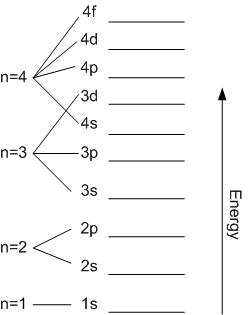
ZapperZ's recent post about new work on the pseudogap in high temperature superconductors has made me think about how to try to explain something like this to scientifically literate nonspecialists. Here's an attempt, starting from almost a high school chemistry angle. Chemists (and spectroscopists) like energy level diagrams. You know - like this one - where a horizontal line at a certain height indicates the existence of a particular (electronic) energy level for a system at some energy. The higher up the line, the higher the energy. In extended solid state systems, there are usually many, many levels. That means that an energy level diagram would have zillions of horizontal lines. These tend to group into bands, regions of energy with many energy levels, separated by gaps, regions of energy with no levels.

Let's take the simplest situation first, where the energies of those levels don't depend on how many electrons we actually have. This is equivalent to turning off the electron-electron interaction. The arrangement of atoms gives us some distribution of levels, and we just start filling it up (from the bottom up, if we care about the lowest energy states of the system; remember, electrons can be spin-up or spin-down, meaning that each (spatial state) level can in principle hold two electrons). There's some highest occupied level, and some lowest unoccupied level. We care about whether the highest occupied level is right up against an energy gap, because that drastically affects many things we can measure. If our filled up system is gapped, that means that the energetically cheapest (electronic) excitation of that system is the gap energy. Having gaps also restricts what processes can happen, since any quantum mechanical process has to take the system from some initial state to some final state. If there's no final state available that satisfies energy conservation, for example, the process can't happen. This means we can map out the gaps in the system by various spectroscopy experiments (e.g., photoemission; tunneling).

So, what happens in systems where the electron-electron interaction does matter a lot? In that case, you should think of the energy levels as rearranging and redistributing themselves depending on how many electrons are in the system. This all has to happen self-consistently. One particularly famous example of what can happen is the Mott insulating state. (Strictly speaking, I'm going to describe a version of this related to the Hubbard model.) Suppose there are N real-space sites, and N electrons to place in there. In the noninteracting case, the highest occupied level would not be near a gap - it would be in the middle of a band. Because the electrons can shuffle around in space without any particular cost to doubly occupying a site, the system would be a metal. However, suppose it costs an energy U to park two electrons on any site. The lowest energy state of the whole system would be each of the N sites occupied by one electron, with an energy gap of U separating that ground state from the first excited state. So, in the presence of strong interactions, at exactly "half-filling", you can end up with a gap. Even without this lattice site picture, in the presence of disorder, it's possible to see signs of the formation of a gap near the highest occupied level (for experts, in the weak disorder limit, this is the Altshuler-Aronov reduction in the density of states; in the strong disorder limit, it's the Efros-Shklovskii Coulomb gap).

Another kind of gap exists in the superconducting state. There is an energy gap between the superconducting ground state and the low lying excitations. In the high temperature superconductors, that gap is a bit weird, since there actually are low-lying excitations that correspond to electrons with very specific amounts of momentum ("nodal quasiparticles").

A pseudogap is more subtle. There isn't a "hard" gap, with zero states in it. Instead, the number of states near the highest occupied level is depressed relative to noninteracting expectations. That reduction and how it varies as a function of energy can tell you a lot about the underlying physics. One complicated aspect of high temperature superconductors is the existence of such a pseudogap well above the superconducting transition temperature. In conventional superconductors (e.g., lead), this doesn't exist. So, the question has been lingering for 25 years now, is the pseudogap the sign of incipient superconductivity (i.e., electrons are already pairing up, but they lack the special coherence required for actual superconductivity), or is it a sign of something else, perhaps something competing with superconductivity? That's still a huge question out there, complicated by the fact that doping the high-Tc materials to be superconductors adds disorder to the problem.

Monday, February 21, 2011

This is why micro/nanofab with new material systems is hard.

Whenever I read a super-enthusiastic news story about how devices based on new material XYZ are the greatest thing ever and are going to be an eventual replacement for silicon-based electronics, I immediately think that the latter clause is likely not true. People have gotten very spoiled by silicon (and to a lesser degree, III-V compound semiconductors like GaAs), and no wonder: it's at the heart of modern technology, and it seems like we are always coaxing new tricks out of it. Of course, that's because there have been millions of person-years worth of research on Si. Any new material system (be it graphene, metal oxide heterostructures, or whatever) starts out behind the eight ball by comparison. This paper on the arxiv this evening is an example of why this business is hard. It's about Bi2Se3, one of the materials classified as "topological insulators". These materials are meant to be bulk insulators (well, at low enough temperature; this one is actually a fairly small band gap semiconductor), with special "topologically protected" surface states. One problem is, very often the material ends up doped via defects, making the bulk relatively conductive. Another problem, as studied in this paper, is that exposure to air, even for a very brief time, dopes the material further, and creates a surface oxide layer that seems to hurt the surface states. This sort of problem crops up with many materials. It's truly impressive that we've learned how to deal with these issues in Si (where oxygen is not a dopant, but does lead to a surface oxide layer very quickly). This kind of work is very important and absolutely needs to be done well....

Tuesday, February 15, 2011

You could, but would you want to?

Texas governor Rick Perry has proposed (as a deliberately provocative target) that the state's (public) universities should be set up so that a student can get a bachelor's degree for $10,000 total (including the cost of books).  Hey, I'm all for moon shot-type challenges, but there is something to be said for thinking hard about what you're suggesting.  This plan (which would set costs per student cheaper than nearly all community colleges, by the way) is not well thought-out at all, which is completely unsurprising.  To do this, the handwave argument is that professors should maximize online content for distance learning, and papers could be graded by graduate students or (apparently very cheaply hired) instructors.  Even then, it's not clear that you could pull this off.  Let me put it this way:  I can argue that the world would benefit greatly from a solar electric car that costs $1,000, but that doesn't mean that one you'd want to own can actually be produced in an economically sustainable way at that price.  This is classic Perry, though. 

Sunday, February 13, 2011

Battle hymn of the Tiger Professor

Like Amy Chua, I'm choosing to be deliberately provocative in what I write below, though unlike her I don't have a book to sell. I recently heard a talk where a well reputed science educator (not naming names) argued that those of us teaching undergraduates need to adapt to the learning habits of "millennials". That is, these are a group of people who have literally grown up with google (a thought that makes me feel very old, since I went to grad school w/ Sergei Brin) - they are used to having knowledge (in the form of facts) at their fingertips in a fraction of a second. They are used to nearly continuous social networking, instantaneous communication, and constant multitasking (or, as a more stodgy person might put it, complete distraction, attention deficit behavior, and a chronic inability to concentrate). This academic argued that we need to make science education mimic real research if we want to produce researchers and get students jazzed about science. Moreover, this academic argued that making students listen to lectures and do problem sets was (a) ineffective, since that's not how they were geared to learn, and (b) somewhere between useless and abusive, being slavishly ruled by a culture of "covering material" without actually educating. Somehow we should be more in tune with how Millennials learn, and appeal to that, rather than being stodgy fogies who force dull, repetitious "exercises at the end of the chapter" work.

While appealing to students' learning modalities has its place, I contend that this concept simply will not work well in some introductory, foundational classes in the sciences, math, and engineering. Physical science (chemistry, physics) and math are inherently hierarchical. You simply cannot learn more advanced material without mastery of the underpinnings. Moreover, in the case of physics (with which I am most familiar), we're not just teaching facts (which can indeed be looked up easily on the internet); we're supposedly teaching analytical skills - how to think like a physicist; how to take a physical situation and translate it into math that enables us to solve for what we care about in terms of what we know. Getting good at this simply requires practice. To take the Amy Chua analogy, hard work is necessary and playdates are not. There literally is no substitute for doing problems and getting used to thinking this way. While open-ended reasoning exercises can be fun and useful (and could be a great addition to the standard curriculum, or perhaps a way to run a lab class to be more like real research), at some point students actually do need to become proficient in basic problem-solving skills. I really don't like the underlying assumption that this educator was making: that the twitter/facebook/short-attention-span approach is unavoidable and possibly superior to focused hard work. Hey, I'm part of the distractable culture as much as anyone in the 21st century, but you'll have to work hard to convince me that it's the right way to teach foundational knowledge in physics, math, and chemistry.

Wednesday, February 09, 2011

Science and the nation

(The US, that is.) More people need to read this.

Sunday, February 06, 2011

Triboelectricity and enduring mysteries of physics

This past week I hosted Seth Putterman for a physics colloquium here at Rice, and one of the things he talked about is some of his group's work related to triboelectricity, or the generation of charge separation by friction/rubbing.  When you think about it, it's quite amazing that we have no first-principles explanation of a phenomenon we're all shown literally as children (rub a balloon on your hair and it builds up enough "static" charge that it will stick to a plaster wall, unless you live in a very humid place like Houston).  The amount of charge that may be moved is on the order of 1012 electrons per square cm, and the resulting potential differences can measure in the tens of kilovolts (!), leading to remarkable observations like the generation of x-rays from peeling tape, or UV and x-ray emission from a mercury meniscus moving along a glass surface.  In fact, there's still some disagreement about whether the charge moving in some triboelectric experiments is electrons or ions!  Wild stuff.

Sunday, January 30, 2011

Now that's an impressive capability.

The Bad Astronomer periodically makes posts that show just how cool some astro phenomenon or astro observational capability can be. In keeping with this idea, I find this paper to be just damned impressive. (Apologies for the subscription-only link.) The investigators at Oxford University have one of the best and fanciest transmission electron microscopes (TEM) in the world. In TEM, a highly focused (on the atomic scale!) beam of electrons is fired through a very thin (under 100 nm thick) sample, and the transmitted electrons are analyzed as the beam is scanned over the sample surface. By using very clever electron optics techniques (aberration correction) and the right choice of samples, the investigators have been able to watch the motion of single atoms and few-atom clusters (of praesodymium, which has a big atomic number and therefore interacts strongly with the electron beam) within a carbon nanotube. They can study the formation of 1d crystals this way. Very impressive imaging tool. I want one :-)

Saturday, January 29, 2011

Not even wrong.

No, I'm not talking about Peter Woit's website or Wolfgang Pauli.  Instead, I mean this article, which shows that Allstate Insurance apparently thinks that it's meaningful to look at car accident risk as a function of the astrological sign of the driver.  Astrology?  A major company using astrology?  We're supposed to believe that there is a statistically meaningful correlation between the time of the year you're born and your driving ability?  This is why there is a crying need for math and science literacy.

Saturday, January 22, 2011

Cold fusion (err, low energy nuclear reactions) yet again.

I'm starting to know how Phil Plait must feel every time he has to write yet another article about how Betelgeuse is not about to explode.  (Though my readership is about 0.01% of the Bad Astronomer's)

Once again, there is a claim receiving attention from various media sources (here, here, here) that someone has demonstrated some gadget that produces so much "excess heat" that the conjectured source of the energy is some kind of nuclear reaction taking place in a condensed matter environment.  This time, it's two Italian researchers, and they have demonstrated (in some very restricted way, more on this below) a device that they say uses a reaction involving nickel and ordinary hydrogen.  The claim is that for a steady state input power of 400 watts, they can produce around 12 kW steady state of power in the form of heat.  The device when running supposedly takes in room temperature water at some rate and outputs dry steam, and doing the enthalpy balance and water flow rate is how one gets the 12 kW figure.  Crucially, the claim is that this whole process only consumes a tiny amount of hydrogen (far too little for some kind of chemical combustion to be the source of all the heat).  The conjectured nuclear reaction is some pathway from 62Ni + p -> 63Cu.  No big radiation produced, though of course the demo doesn't really allow proper measurements.   Don't even bother reading the would-be theoretical "explanation" - it's ridiculously bad physics, and completely beside the point.  What's really of interest is the experimental question.

As always in these cases, there are HUGE problems with all of this.  The would-be paper is "published" in an online journal run by one of the claimants.  The claimants won't let independent people examine the apparatus.  They also don't do the completely obvious demonstration - setting up a version that runs in closed cycle (that is, take some of that 12 kW worth of steam flow, and generate the 400 W of electrical power needed to keep the apparatus running, and just let the system run continuously).  If the process really is nuclear in origin, and the hydrogen accounting is correct, it should be possible to run such a system continuously for months or longer.  The claimants say that they've been using a 10 kW version of such a unit to heat a factory in Italy for the past year, but they conveniently don't show that to anyone.

The burden of proof is on these people - if they've really done this, the world will beat a path to their door, and that would be great.  I'm not buying my nickel futures yet, however.  Once again there will be people out there who claim that evil scientists are suppressing these unorthodox geniuses; this is such a ridiculous mischaracterization of science that it still ticks me off every time I read it.  Of course I wish this were a genuine discovery - it would be world-changing and reveal enormous new physics.  However, so far no version of this kind of low energy nuclear reaction business has passed the bar of reasonable reproducibility in controlled circumstances.  (See here for a past discussion concerning the palladium variety and its reproducibility.   Read the comments there before posting angrily below that I don't understand the situation, or that I haven't looked at this, or that I'm otherwise hugely ignorant on the subject.)  That's not the establishment being oppressive, it's the way good science works.  Extraordinary claims require extraordinary evidence.  The self-sustaining demo I described above with independent verification and measurements would go a long way.  I'm not holding my breath.

Tuesday, January 18, 2011

Various and sundry

Here are a number of links that may be of interest:

Back in December, Steven Blau at Physics Today wrote an interesting blog post about the arrogance of physicists. For some reason I just came across this today. Prof. Stone's comment on the post is, I think, right on the mark, and reminds me of this xkcd comic.

Here is a series of four blog posts (one, two, three, four) from Mike Mayberry at Intel, to give you a sense of some of the research directions they're pursuing as we near the possible end of scaling for conventional Si-based FETs. Very interesting stuff on the challenges of integrating other materials (like III-V compound semiconductors) with Si.

Veering into humor, here is a video made by Adam Ruben, whom I know through the alumni network of the Princeton Band. It's called "The Grad Student Rap", and it's part of the promotion for his book, Surviving Your Stupid, Stupid Decision to go to Graduate School.

Thursday, January 13, 2011

This just in: a Nobel in medicine does not imply knowledge of basic physics.

Having read something about this online, I had to see for myself.  Take a look at this paper.  One of the 2008 Nobel laureates for medicine is the lead author, and he claims that simply having certain kinds of DNA in water (1) creates electromagnetic waves at very low frequencies, like 7 Hz; (2) those waves are sufficiently strong that a simple pickup coil of copper wire can be used to detect them inductively; and (3) somehow those waves continue to self-propagate in a weird way so that repeated dilution of the solution preserves the "imprint" of those waves.  Wow.  The science here is so unbelievably bad, it's hard to imagine that this is serious.  A pick-up coil?!  No serious discussion of the magnitude of the effect, and whether it's even remotely credible that detectable inductive signals could be produced?  Silly numerology demonstrating a complete lack of understanding of quantum mechanics?  Impressive.  Can we make a deal?  Medicine laureates won't make crazy, misinformed claims about physics (which then naturally get picked up by the media, who love to report "the controversy", as if there is no such thing as a right or wrong answer to a scientific question), and physics laureates won't make crazy, misinformed claims about biology.  Please?

Blast from the past

Yesterday I received a very nice and welcome email from a faculty member who had been one of my best classroom instructors in graduate school. This email was, effectively, a reply to an email that I had sent him regarding Stanford's graduate physics curriculum. The amusing bit is that I had sent him that email 14 years ago, when I was a senior grad student representative to Stanford's physics graduate committee. At the time, there had been ongoing discussions about what topics should be in the first-year graduate curriculum, particularly the "mechanics" sequence, and my opinion had been asked for. It's interesting to look back now as a faculty member at what I'd suggested at the time. Here are the bullet point topics I'd suggested. Remember that Stanford is on the quarter system, meaning that there are three ten-week quarters during the regular academic year.

For "Mechanics of Particles" (basically graduate mechanics and dynamics), I'd said:
- Brief review of variational calculus
- Lagrangians and Hamiltonians, action principle
- Canonical transformations, phase space
- Symmetries and conservation laws (Noether's thm?)
- Normal modes, harmonic oscillator review
- Rigid body motion (numerical work?)
- Orbital mechanics review
- Classical perturbation theory (w/ orbits, rigid body dynamics, anharmonic oscillator)
- Action-angle variables
- Poisson brackets, symplectic structure (*definitions of 1-forms, tangent spaces, tangent bundles?)
- Chaos, nonlinear dynamics, ergodicity
- Brief review of Einstein summation convention
- Special relativity w/ Einstein summation convention, space-time diagrams

For "Continuum mechanics" (fairly unique, I now realize - many departments offer no such course), my suggestions reflected my undergrad engineering background to some degree. I now realize that what I list below is considerably too much for a 10 week course:
- Mechanics of solids:
+ Continuum mechanics version of Hooke's law; stress, strain, tension, compression, shear, bulk modulus, a few numbers about strength of materials, Young's modulus, shear modulus
+ Lagrangian/Hamiltonian densities, more variational calculus
+ *Flexure of beams, bending moments, areal moments of inertia (why I-beams are stiffer than rods of the same cross-sectional area)
+ *Torsion of members, polar "moments of inertia"
+ *Dynamics of beams: the wave equation, longitudinal and transverse sound, natural frequencies of cantilevers
+ Acoustics, idea of acoustic impedance and mismatch
- Fluid statics
+ Hydrostatics, Archimedes' principle, buoyancy
+ *Surface tension, capillary action, wetting
- Fluid mechanics
+ Euler and Lagrange pictures
+ "Convective derivatives", transport of momentum and energy
+ The energy equation, the momentum equation, the continuity equation, the Navier-Stokes equation
+ Inviscid, incompressible flow:
- Bernoulli's Eqn.
- Potential theory
- *Vorticity, circulation, Magnus' law, "lift"
+ Viscous, incompressible flow:
- Definition of viscosity, comparison w/ shear modulus, definition of Newtonian fluid
- Stoke's law
- Intro to dimensional analysis, Reynolds' number
- Laminar flow, parabolic velocity profile in a round pipe
- Turbulent flow, mention engineering approach to these problems (Moody chart, friction factor, Bernoulli w/ losses)
- Froud number, hydraulic jumps (example of a "shock" discontinuity that you can demonstrate in a sink)
+ Compressible flow
- Mention of shockwaves, scaling

For "Statistical Mechanics", the main challenge was dealing with the divergent backgrounds of incoming students - some people had very strong undergrad preparation in statistical and thermal physics, others much less so. This is an issue in graduate quantum mechanics to an even greater degree. Now that I've taught undergrad stat mech several times, I think what I listed below could use some additional advanced topics:
- Definition of entropy, why it's a log
- The equal prob. postulate/ergodic thm.
- The Boltzmann factor and the partition fn., Fermi and Dirac distributions
- *Mention of Feynman diagram methods, saddle-point integration to get Z in complicated systems
- The canonical and grand canonical ensembles, the chemical potential
- "Natural" variables, Legendre transforms, thermodynamic potentials, *the idea of a constrained maximization of S, the Maxwell relations, the "thermodynamic square"
- Gases
+ Ideal classical
+ Van der Waals, virial coefficients
+ Fermi gas at zero and finite T
+ Ideal Bose gas, BEC, phonons & photons *(incl. laser discussion!)
- Liquids - diagrammatic methods of treating interactions?
- Solids
+ Phonons
+ Concept of long-range order
- *Correlation functions, *connection w/ susceptibilities
- *Correlations and fluctuations, *how they're measured!
- Theories of phase transitions
+ Concept of order parameter
+ Ginsberg-Landau theory, diff. betw. 1st and 2nd order, extensions to include fluctuations
+ 1st order: Van der Waals reprise, Clausius-Clapeyron
+ Mean-field theory, example of magnetism
+ Ising model in 1-d
+ Renormalization group to solve Ising model, critical behavior, correlation length ideas
- *Transport
+ *Boltzmann equation
+ *Noise in transport: fluctuation/dissipation thm
It was definitely interesting to me to see how my thinking on this stuff has evolved now that I have to teach it.

Sunday, January 09, 2011

Friction - sometimes electrons matter!

While I don't do any research on the subject myself, over the last few years I've become more interested in the origins of friction, a subject about which almost no physics progress was made between from around 1650 to 1950. Since the development of the tools of surface science (ultrahigh vacuum, for example) and scanned probe microscopy, however, people have learned much about where friction comes from.

We all have an intuitive grasp of what friction is, and in freshman physics (or even high school), we learn that we can model friction as a (shear) force between two surfaces as they slide (or attempt to slide) relative to one another. That force is modeled as proportional to the normal force between the surfaces, with the surface-dependent friction coefficient as the proportionality constant. The force is further traditionally modeled as being independent of the contact area between the two surfaces, and independent of the relative speeds of the two surfaces (except for the distinction between static friction - with no relative motion - and kinetic or sliding friction). That approach does a very good job at describing many many experiments on friction between macroscopic objects.

The problem is, as many famous scientists (e.g., Coulomb) discovered, it's very difficult to come up with a microscopic model of the interaction between surfaces that has these properties. One of the essential difficulties is rather deep: friction has to result in real dissipation. Energy has to be transferred from macroscopic degrees of freedom (the motion of a hockey puck relative to the ice) into microscopic degrees of freedom (the relative vibrational motions of the atoms in the hockey puck, and similar motions of the atoms in the ice - heat, in short.). That transfer of energy from macroscopic coordinates to microscopic motions or coordinates is irreversible in the same sense that the motion of water in a pond is irreversible after a stone is tossed in. (Yes, it's physically conceivable from the point of view of Newton's laws that all the little bits of water at the edge of the pond could jiggle just right so as to send coordinated ripples inward toward the center of the pond, spitting the stone back out. However, that's incredibly unlikely, given all of the possible microscopic states of the water, so from the standpoint of macroscopic thermodynamics, the water rippling process is irreversible.)

There has been some beautiful work on friction at the nanoscale, and much of it has focused on chemical interactions between surfaces, as well as vibrations (phonons) as the relevant microscopic degrees of freedom. However, in the case of metals, there are other excitations where the energy could end up: electrons! That's one defining characteristic of a metal, the existence of possible electronic excitations of (almost) arbitrarily low energy. How can you tell if the energy is ending up in the electrons? Well, you'd really like to do an experiment where none of the vibrational properties are changed, but that allows you to compare between with-electrons and without-electrons. Amazingly, it is possible to do something close to that by working with a metal that is superconducting! Above the superconducting transition temperature, Tc, the metal has plenty of low energy electronic excitations. Below Tc, however, in the superconducting state, electronic excitations are forbidden below some threshold energy (this "gap" in the excitation spectrum is one key reason why superconductors have no electrical resistance). In this new paper (sorry about not having an arxiv version to link), the investigators have demonstrated that the (noncontact) friction between a metal tip and a niobium film drops dramatically once the niobium becomes superconducting. This argues that electronic dissipation is responsible for much of the friction in this case (in the normal state). I should point out that previous work with lead films had hinted at similar physics.  The new experiment is very clear and benefits from technique developments in the meantime.

Thursday, January 06, 2011

Spin-orbit coupling

Happy new year! I want to write a little about what physicists call spin-orbit interactions. It turns out that there is a deep connection between electric and magnetic fields that can be made somewhat obvious by considering a thought experiment. (For a great discussion of this, see the textbook by Purcell.) Imagine a line of stationary positive charges. From our perspective (at rest relative to the line of charges), there is no current, so one should see an electric field pointed radially outward from the line of charges, and a positive charge placed next to the line of charges should respond accordingly, being pushed radially outward. Now consider viewing this from a reference frame moving parallel to the line of charges. From our point of view in that frame, we see a current, and therefore there should be a magnetic field associated with that current (as well as an electric field from the net positive charge). In special relativity, one can figure out how electric and magnetic fields transform into and out of each other when changing reference frames.

This shift of point of view is the way that spin-orbit coupling is usually explained in undergrad quantum mechanics. Consider a hydrogen atom. The electron zipping around the proton has a spin degree of freedom, and a corresponding magnetic moment. From the point of view of the (classically) moving electron, the proton is essentially a current producing a magnetic field, which will tend to align the electron magnetic moment. This couples the spin of the electron to the orbital motion of the electron; hence the name "spin-orbit coupling"; and it is technically a relativistic effect which tends to be bigger in heavier atoms.

Why should you care? Well, spin-orbit coupling can be important in solids, too, since one can think of their electronic states as being built out of atomic orbitals. As ZapperZ points out, a recent paper shows that these kinds of relativistic corrections are not necessarily tiny in ordinary, everyday solids.  In fact, it appears that it is essential to worry about such relativistic effects in order to understand why the electrochemical redox potentials of an ordinary car battery are what they are!

Wednesday, December 29, 2010

Behold the power of good lab notebook practice!

I was just able to help out my postdoc by pulling an old Bell Labs notebook from 11.5 years ago off my bookshelf and showing him a schematic of an electrical measurement technique. This is an object lesson in why it is a good idea to keep a clear, complete lab notebook! I try very hard to impress upon undergrad and graduate students alike that it's critically important to keep good notes, even (perhaps especially) in these days of electronic data acquisition and analysis. I've never once looked back and regretted how much time I spent writing things down, or how much paper I used - good record keeping has saved my bacon (and lots of time) on multiple occasions. Unfortunately, with rare exceptions, students come in to the university (at the undergrad or grad levels) and seem determined to write as little as possible down using as few sheets of paper as they can manage. Somewhere along the way (before grad school, though my thesis advisor was outstanding about this), it got pounded into my brain: if you didn't document it, you didn't do it. Perhaps we should make a facebook-like or twitter-like application that would sucker student researchers into obsessively updating their work status....

Tuesday, December 28, 2010

Statistical mechanics: still work to be done!

Statistical mechanics, the physics of many-particle systems, is a profound intellectual achievement.  A statistical approach to systems with many degrees of freedom makes perfect sense.  It's ridiculous to think about solving Newton's laws (or the Schroedinger equation, for that matter) for all the gas molecules in this room.  Apart from being computationally intractable, it would be silly for the vast majority of issues we care about, since the macroscopic properties of the air in the room are approximately the same now as they were when you began reading this sentence.  Instead of worrying about every molecule and their interactions, we characterize the macroscopic properties of the air by a small number of parameters (the pressure, temperature, and density).  The remarkable achievement of statistical physics is that it places this on a firm footing, showing how one can go from the microscopic degrees of freedom, through a statistical analysis, and out the other side with the macroscopic parameters.  

However, there are still some tricky bits, and even equilibrium statistical mechanics continues to be an active topic of research.  For example, one key foundation of statistical mechanics is the idea of replacing time-averages with energy-averages.  When we teach stat mech to undergrads, we usually say something like, a system explores all of the microscopic states available to it (energetically, and within other constraints) with equal probability.  That is, if there are five ways to arrange the system's microscopic degrees of freedom, and all five of those ways have the same energy, then the system in equilibrium is equally likely to be found in any of those five "microstates".  How does this actually work, though?  Should we think of the system somehow bopping around (making transitions) between these microstates?  What guarantees that it would spend, on average, equal time in each?  These sorts of issues are the topic of papers like this one, from the University of Tokyo.  Study of these issues in classical statistical mechanics led to the development of ergodic theory (which I have always found opaque, even when described by the best in the business).  In the quantum limit, when one must worry about physics like entanglement, this is still a topic of active research, which is pretty cool. 

Monday, December 20, 2010

Science's Breakthrough of the Year for 2010

Science Magazine has named the work of a team at UCSB directed by Andrew Cleland and John Martinis as their scientific breakthrough of the year for 2010.  Their achievement:  the demonstration of a "quantum machine".  I'm writing about this for two reasons.  First, it is extremely cool stuff that has a nano+condensed matter focus.  Second, this article and this one in the media have so many things wrong with them that I don't even know where to begin, and upon reading them I felt compelled to try to give a better explanation of this impressive work.

One of the main points of quantum mechanics is that systems tend to take in or emit energy in "quanta" (chunks of a certain size) rather than in any old amount.  This quantization is the reason for the observation of spectral lines, and mathematically is rather analogous to the fact that a guitar string can ring at a discrete set of harmonics and not any arbitrary frequency.   The idea that a quantum system at low energies can have a very small number of states each corresponding to a certain specific energy is familiar (in slightly different language) to every high school chemistry student who has seen s, p, and d orbitals and talked about the Bohr model of the atom.  The quantization of energy shows up not just in the case of electronic transitions (that we've discussed so far), but also in mechanical motion.  Vibrations in quantum mechanics are quantized - in quantum mechanics, a perfect ball-on-a-spring mechanical oscillator with some mechanical frequency can only emit or absorb energy in amounts of size hf, where h is Planck's constant.  Furthermore, there is some lowest energy allowed state of the oscillator called the "ground state".  Again, this is all old news, and such vibrational quantization is clear as a bell in many spectroscopy techniques (infrared absorption; Raman spectroscopy). 

The first remarkable thing done by the UCSB team is to manufacture a mechanical resonator containing millions of atoms, and to put that whole object into its quantum ground state (by cooling it so that the thermal energy scale is much smaller than hf for that resonator).  In fact, that's the comparatively easy part.  The second (and really) remarkable thing that the UCSB team did was to confirm experimentally that the resonator really was in its ground state, and to deliberately add and take away single quanta of energy from the resonator.  This is very challenging to do, because quantum states can be quite delicate - it's very easy to have your measurement setup mess with the quantum system you're trying to study!

What is the point?  Well, on the basic science side, it's of fundamental interest to understand just how complicated many particle systems behave when they are placed in highly quantum situations.  That's where much of the "spookiness" of quantum physics lurks.  On the practical side, the tools developed to do these kinds of experiments are one way that people like Martinis hope to build quantum computers.  I strongly encourage you to watch the video on the Science webpage (should be free access w/ registration); it's a thorough discussion of this impressive achievement.

Tuesday, December 14, 2010

Taking temperatures at the molecular scale

As discussed in my previous post, temperature may be associated with how energy is distributed among microscopic degrees of freedom (like the vibrational motion of atoms in a solid, or how electrons in a metal are placed into the allowed electronic energy levels).  Moreover, it takes time for energy to be transferred (via "inelastic" processes) among and between the microscopic degrees of freedom, and during that time electrons can actually move pretty far, on the nano scale of things.  This means that if energy is pumped into the microscopic degrees of freedom somehow, it is possible to drive those vibrations and electronic distributions way out of their thermal equilibrium configurations. 

So, how can you tell if you've done that?  With macroscopic objects, you can think about still describing the nonequilibrium situation with an effective temperature, and measuring that temperature with a thermometer.  For example, when cooking a pot roast in the oven (this example has a special place in the hearts of many Stanford graduate physics alumni), the roast is out of thermal equilibrium but in an approximate steady state.  The outside of the roast may be brown, crisp, and at 350 F, while the inside of the pot roast may be pink, rare, and 135 F.  You could find these effective temperatures (effective because strictly speaking temperature is an equilibrium parameter) by sticking a probe thermometer at different points on the roast, and as long as the thermometer is small (little heat capacity compared to the roast), you can measure the temperature distribution.

What about nanoscale systems?  How can you look at the effective temperature or how the energy is distributed in microscopic degrees of freedom, since you can't stick in a thermometer?  For electrons, one approach is to use tunneling (see here and here), which is a topic for another time. In our newest paper, we use a different technique, Raman spectroscopy

In Raman, incoming light hits a system under study, and comes out with either less energy than it had before (Stokes process, dumping energy into the system) or more energy than it had before (anti-Stokes process, taking energy out of the system).  By comparing how much anti-Stokes Raman you get vs. how much Stokes, you can back out info about how much energy was already in the system, and therefore an effective temperature (if that's how you want to describe the energy distribution).  You can imagine doing this while pushing current through a nanosystem, and watching how things heat up.  This has been done with the vibrational modes of nanotubes and graphene, as well as large ensembles of molecules.  In our case, through cool optical antenna physics, we are able to do Raman spectroscopy on nanoscale junctions, ideally involving one or two molecules.  We see that sometimes the energy input to molecular vibrations from the Raman process itself is enough to drive some of those vibrations very hard, up to enormous effective temperatures.  Further, we can clearly see vibrations get driven as current is ramped up through the junction, and we also see evidence (from Raman scattering off the electrons in the metal) that the electrons themselves can get warm at high current densities.  This is about as close as one can get to interrogating the energy distributions at the single nanometer scale in an electrically active junction, and that kind of information is important if we are worried about how dissipation happens in nanoelectronic systems. 

Monday, December 13, 2010

Temperature, thermal equilibrium, and nanoscale systems

In preparation for a post about a new paper from my group, I realized that it will be easier to explain why the result is cool if I first write a bit about temperature and thermal equilibrium in nanoscale systems.  I've tried to write about temperature before, and in hindsight I think I could have done better.  We all have a reasonably good intuition for what temperature means on the macroscopic scale:  temperature tells us which way heat flows when two systems are brought into "thermal contact".  A cool coin brought into contact with my warm hand will get warmer (its temperature will increase) as my hand cools down (its temperature will locally decrease).  Thermal contact here means that the two objects can exchange energy with each other via microscopic degrees of freedom, such as the vibrational jiggling of the atoms in a solid, or the particular energy levels occupied by the electrons in a metal.  (This is in contrast to energy in macroscopic degrees of freedom, such as the kinetic energy of the overall motion of the coin, or the potential energy of the coin in the gravitational field of the earth.)

We can turn that around, and try to use temperature as a single number to describe how much energy is distributed in the (microscopic) degrees of freedom.  This is not always a good strategy.  In the coin I was using as an example, you can conceive of many ways to distribute vibrational energy.  Number all the atoms in the coin, and have the even numbered atoms moving to the right and the odd numbered atoms moving to the left at some speed at a given instant.  That certainly would have a bunch of energy tied up in vibrational motion.  However, that weird and highly artificial arrangement of atomic motion is not what one would expect in thermal equilibrium. Likewise, you could imagine looking at all the electronic energy levels possible for the electrons in the coin, and popping every third electron each up to some high unoccupied energy level.   That distribution of energy in the electrons is allowed, but not the sort of thing that would be common in thermal equilibrium.  There are certain vibrational and electronic distributions of energy that are expected in thermal equilibrium (when the system has sat long enough that it has reached steady-state as far as its statistical properties are concerned).

How long does it take a system to reach thermal equilibrium?  That depends on the system, and this is where nanoscale systems can be particularly interesting.  For example, there is some characteristic timescale for electrons to scatter off each other and redistribute energy.  If you could directly dump in electrons with an energy 1 eV (one electron volt) above the highest occupied electronic level of a piece of metal, it would take time, probably tens of femtoseconds, before those electrons redistributed their energy by sharing it with the other electrons.  During that time period, those energetic electrons can actually travel rather far.  A typical (classical) electron velocity in a metal is around 106 m/s, meaning that the electrons could travel tens of nanometers before losing their energy to their surroundings.  The scattering processes that transfer energy from electrons into the vibrations of the atoms can be considerably slower than that! 

The take-home messages: 
1) It takes time for electrons and vibrations arrive at a thermal distribution of energy described by a single temperature number.
2) During that time, electrons and vibrations can have energy distributed in a way that can be complicated and very different from thermal distributions.
3) Electrons can travel quite far during that time, meaning that it's comparatively easy for nanoscale systems to have very non-thermal energy distributions, if driven somehow out of thermal equilibrium.

More tomorrow.

Saturday, December 11, 2010

NSF grants and "wasteful spending"

Hat tip to David Bacon for highlighting this.  Republican whip Eric Cantor has apparently decided that the best way to start cutting government spending is to have the general public search through NSF awards and highlight "wasteful" grants that are a poor use of taxpayer dollars.

Look, I like the idea of cutting government spending, but I just spent two days in Washington DC sitting around a table with a dozen other PhD scientists and engineers arguing about which 12% of a large group of NSF proposals were worth trying to fund.  I'm sure Cantor would brand me as an elitist for what I'm about to write, but there is NO WAY that the lay public is capable of making a reasoned critical judgment about the relative merits of 98% of NSF grants - they simply don't have the needed contextual information.  Bear in mind, too, that the DOD budget is ONE HUNDRED TIMES larger than the NSF budget.  Is NSF really the poster child of government waste?  Seriously?