Search This Blog

Monday, March 14, 2022

APS March Meeting 2022, Day 1

My first impressions of this year's March Meeting are a bit limited, since I flew today and didn't make it to the convention center until around 4pm.  Still, a few thoughts:

  • Population density at the meeting does seem lower than 2019, though that could partly be because the convention center is enormous.  Attendance also seems to skew younger this year.
  • It was interesting attending a contributed session, with a mix of in-person speakers and the session chair playing pre-recorded presentations from those who could not or chose not to be present.  It seems to work ok, though the lack of Q&A for the recorded talks takes some getting used to.  In asking around, I get the impression that the full live streaming interactive Q&A approach from last year's virtual meeting was very expensive to implement, and that's one reason why the method this year is different (with live streaming only for invited talks).
  • While I was getting my bearings, I popped into a session about spin transport by electrons and magnons.  I saw a talk where an interesting "spin diode" effect takes place in a thin film multilayer structure consisting of (from one side to the other) permalloy/gold/platinum/cobalt.  Driving the permalloy layer into ferromagnetic resonance can effectively pump spin into the gold and so forth, and in that direction spin current flows and is absorbed in the cobalt.  However, if one instead drives the cobalt layer to try to push a spin current the other way, the permalloy does not act like a "sink".  This can be modeled and the directionality makes sense.
  • I saw a second talk that somewhat similar in spirit, in which magnons are launched into an insulating magnet using the spin Hall effect in a Pt wire, and then detected by another Pt wire via the inverse spin Hall effect.  By placing a NiFe pad between the Pt wires, it is possible to make it so that magnons transport more easily from one Pt wire to the other than vice versa.  This work is described here.
  • Then I went to the APS special session about Ukraine.  I expected this to be largely about how to help displaced scholars and scientists, but it was more complex, and most of the time was a listening session for the APS president and the CEO.  The APS statements about the Russian invasion of Ukraine are here.  There are many issues.  For example, 200+ rectors of top Russian universities and institutes signed an open letter supporting the war. Should the APS still allow those places to have journal access? Faculty members there to have society membership and privileges? What is mandated as a result of sanctions?  There are many Ukrainian and Russian and Belarusian physicists in the APS, and feelings are intense.  On an historical note, the question was raised about what if anything the APS did in regard to German physicists and institutions (like the German Physical Society and the Kaiser Wilhelm Institutes) when Germany invaded Poland in 1939 - can any readers point to a record of what the APS actually did?  I spent a while googling and could find nothing.
It is good to see folks face to face, even if attendance is down.  It's been a long time.

Thursday, March 10, 2022

2022 March APS Meeting - coming soon.

I will actually be attending the 2022 March APS Meeting in Chicago next week, so look for posting to pick up as I try to be good about my annual routine of reporting some highlights.  I have been so busy in recent weeks that I really have not had time to go through the meeting program in any depth; if there are particularly exciting sessions that people want to recommend, please point them out in the comments.

Friday, February 25, 2022

Three papers to distract from the awfulness

Here are three papers that may briefly divert you from doomscrolling about the horrific situation in Ukraine.

  • This paper from the Feb 11 issue of Science shows some amazing images of the calcite structures that make up starfish skeletons, with order on multiple length scales that leads to remarkable mechanical properties.   Biomineralization is amazing, especially when you think about how it works.  Cells generate protein structures that can have charge patterns that allow templating of inorganic crystal growth in specific phases and orientations.  See here for examples of experiments that get at how this works.  The cover image from the Science paper is really eye-popping.
  • Then there's this paper from the Young group at UCSB, which shows that ordinary Bernal-stacked bilayer graphene can also superconduct, albeit at 30 mK.  The really interesting bit here is that to get superconductivity requires both a large c-directed electric field (obtained by having a voltage difference between top and bottom graphite gate electrodes above and below the bilayer) and an in-plane magnetic field.  That latter requirement suggests that this might be an exotic superconductivity where the electron pairs are spin triplets rather than the conventional singlets of ordinary superconductors.
  • Finally, enjoy this paper, which was published as a commentary in ACS Photonics, and is absolutely worth reading for the tone alone.  


Sunday, February 13, 2022

Brief items - fun and games, news, and lots of transistors

My busiest time of the year continues.  A few interesting links:

  • I'm sure you've heard of wordle.  There are some other free games that are similar in design (and not co-opted by the New York Times) that are also good to keep your brain tuned up.  Mathler is cute (and knows order of operation), and worldle, while difficult to pronounce, is fun if you want to keep up with your geography.
  • The US presidential science advisor resigned this week, apparently because he is just an awful person to work with.  That prompted this article from Stat, which advances a thesis that I don't buy, that this resignation shows that we are leaving the era of "big ego science".  I hope that we are finally entering an era where bullying and pushiness are not automatically tolerated in high profile positions, but drawing some sweeping conclusion from Lander's departure is not reasonable to me.  I do know from interactions with folks like my colleague Neal Lane that it is possible for top-flight scientific leaders to be both highly accomplished and genuinely nice people.  I hope someone in that mold ends up taking the reins.
  • The US House passed the 2022 version of the America COMPETES act.  The US Senate had passed the related US Innovation and Competition Act (USICA) last summer.  Now it's up to the conference committee to try to work out a compromise bill that can pass both houses.  If this passed and the House actually appropriated the funds, it would be big news for NSF and the DOE Office of Science.  I'm a bit cynical about the prospect of this happening, and both bills have issues, but it's better to have this at least in front of Congress than languishing off-stage.
  • There are rumors that Nvidia's next big chip will be built on the TSMC "5 nm node" process (where the numbering really doesn't mean that a critical lengthscale is 5 nm) and hold 140 billion transistors (!!).  If anyone asks you whether nanotechnology is meaningful, point to things like that as examples of nanoelectronics.  

Saturday, January 29, 2022

Graduate stipends and tuition - a bold move by Princeton

I will write more about actual physics soon, but it has been a very busy period with other commitments.  In the meantime....

Princeton did something remarkable this week.  They raised their graduate stipends across the board to $40K/10 months, roughly a 25% increase.  That's already quite impressive, but the really wild change is less readily apparent.

It's important to understand how graduate students are paid on research grants in the US.  Grants pay for the stipend + indirect costs ("overhead") on the stipend + tuition remission.  "Tuition remission" is some effective graduate tuition rate.  Indirect costs ("overhead") go to the university and are meant to pay for things like keeping the lights on and the buildings air conditioned and the cost of running the office that does the financial reporting, etc.  Indirect cost rates are set by negotiations between the university and the US government.  Rice's indirect cost rate right now for on-campus research is 56.5%.   

Tuition is trickier.  These are funds meant to cover the university's cost of graduate education.  Different universities do different things with that money they take in on grants for tuition remission - usually it covers things like support for first-year grad students, part of the TA salary pool, etc.  In STEM doctoral programs in the US, students do not pay tuition out of pocket.  It is either waived by the university (for incoming students supported on fellowship or TA, for example) or paid through research grants for students supported by external funding.  (Note that this is money that doctoral students never actually see - that's why it's dumb that every few years (here is the 2017 example) someone in Congress tries to argue it should be taxed.)  It's unclear what a true fair value is for doctoral tuition; grad students are much more independent than undergrads, and when they are doing purely thesis research it's not clear how to think about their educational costs.  Rice has a "tuition remission rate" of 38.5%, rather than a fixed dollar amount, with the idea that this strikes a balance between beginning students taking a lot of courses and later students working only on their thesis.   That means that if our graduate stipend is $S, then on a federal grant the total cost of a doctoral student at Rice is \( (1.565 + 0.385)\times\) $S.   

Anyway, along with raising stipends drastically, Princeton also cut their graduate tuition rate to zero (!).  That means that a graduate student at Princeton will cost less on a grant now than before, even though they have jumped up stipends by 25%.  

This is pretty radical.  The university is going to take in many millions of dollars less on grants to do this, but given their roughly $38B endowment, they can afford it.  Even if they took a $40K hit per grad student per year, the $100M of "lost" income would only be 5% of their operating budget.  I assume that this also plays well against the criticism that elite institutions don't spend enough of their resources.  No idea what the implication is for, e.g., their professional masters degrees in engineering, where they surely charge students (or their employers) substantial graduate tuition.

The long-term effect of this will be interesting and complicated.  I would think that STEM faculty at other comparably wealthy universities will turn to their administrations and ask why students are so much cheaper on grants for Princeton faculty.  This zero doctoral tuition approach would require wholesale restructuring of financial models at most US universities.

Update:  President Eisgruber has publicly announced the tuition change here in his state-of-the-university address.

Saturday, January 15, 2022

Brief items - papers, packings, books

 It's a very busy time, so no lengthy content, but here are a few neat things I came across this week.

  •  A new PRL came out this week that seems to have a possible* analytic solution to Hilbert's 18th problem, about the density of random close-packed spheres in 2D and 3D.  This is a physics problem because it's closely related to the idea of jamming and the onset of mechanical rigidity of a collection of solid objects.  (*I say possible only because I don't know any details about any subtle constraints in the statement of the problem.)
  • The Kasevich group at Stanford has an atom interferometric experiment that they claim is a gravitational analog of the Aharonov-Bohm effect.  This is a cool experiment, where there is a shift in the quantum phase of propagating atomic clouds due to the local gravitational potential caused by a nearby massive object.  (Phase goes like the argument of \(\exp(-i S(x(t))/\hbar)\), where the action can include a term related to the gravitational potential, \(m \times \Phi_{G}(x(t)\).)  At a quick read, though, I don't see how this is really analogous to the AB effect.  In the AB case, there is a relative phase due to magnetic flux enclosed by the interfering paths even when the magnetic field is arbitrarily small at the actual location of the path.  I need to read this more closely, or perhaps someone can explain in the comments.
  • A colleague pointed out to me this great review article all about charge shot noise in mesoscopic electronic systems.  
  • Speaking of gravity, there has been interest in recent years about "warp drives", geometries of space-time allowed by general relativity that seem to permit superluminal travel for an observer in some particular region.  One main objection to these has been that past proposed incarnations violate various energy conditions in GR - requiring enormous quantities "negative matter", for example, which does not seem to exist.  Interestingly, people have been working on normal-matter-only ideas for these, and making some progress as in this preprint.  Exercises like this can be really important for illuminating subtle issues with GR, just like worrying about "fast light" experiments can make us refine arguments about causality and signaling.  
  • Thomas Wong from Creighton University has a free textbook (link on that page) to teach about quantum computing, where the assumed starting math knowledge is trig.  It looks very accessible!
  • People recommended two other books to me recently that I have not yet had time to read.  The Alchemy of Us is a materials-and-people focused book from Ainissa Ramirez, and Sticky: The Secret Science of Surfaces is all about surfaces and friction, by Laurie Winkless.  Gotta make time for these once the semester craziness is better in hand....

Saturday, January 08, 2022

Condensed matter and a sense of wonder

I had an interesting conversation with a colleague last week about the challenges of writing a broadly appealing, popular book about condensed matter.  This is a topic I've been mulling for (too many) years - see this post from the heady days of 2010.

He made a case that condensed matter is inherently less wondrous to the typical science-interested person than, e.g., "the God Particle" (blech) or black holes.  This is basically my first point in the old post linked above.  He was arguing that people have a hard time ever seeing something that captures the imagination in items or objects that they have around them all the time.  The smartphone is an incredible piece of technology and physics, but what people care about is how to get better download speeds, not how or why any of it works.  

I'm curious:  Do readers think this is on-target?  Is "lack of wonder" the main issue, or one of many?  

Friday, December 31, 2021

A book review, and wishes for a happy new year

 I was fortunate enough to receive a copy of Andy Zangwill's recent biography of Phil Anderson, A Mind Over Matter:  Philip Anderson and the Physics of the Very Many.  It's a great book that I would recommend to any physics student or graduate interested in learning about one of the great scientists of the 20th century.  Zangwill does an excellent job with the difficult task of describing (in a way accessible to scientists, if not necessarily always the lay-public) the rise of solid-state physics in the last century and its transformation, with significant guidance from Anderson, into what we now call condensed matter.  This alone is reason to read the book - it's more accessible than the more formally historical (also excellent) Out of the Crystal Maze and a good pairing with Solid State Insurrection (which I discussed here).  

This history seamlessly provides context for the portrait of Anderson, a brilliant, intuitive theorist who prized profound, essential models over computational virtuosity, and who had a litany of achievements that is difficult to list in its entirety.  The person described in the book gibes perfectly with my limited direct interactions with him and the stories I heard from my thesis advisor and other Bell Labs folks.  Some lines ring particularly true (with all that says about the culture of our field):  "Anderson never took very long to decide if a physicist he had just met was worth his time and respect."

On a separate note:  Thanks for reading, and I wish you a very happy new year!  I hope that you and yours have a safe, healthy, and fulfilling 2022.


Monday, December 27, 2021

US News graduate program rankings - bear this in mind

The US News rankings of graduate programs have a surprisingly out-sized influence.  Prospective graduate students seem to pay a lot of attention to these, as do some administrators.  All ranking schemes have issues:  Trying to encapsulate something as complex and multi-variate as research across a whole field + course offerings + student life + etc. in a single number is inherently an oversimplification. 

The USNWR methodology is not secret - here is how they did their 2018 rankings.   As I wrote over a decade ago, it's a survey.  That's all.  No detailed metrics about publications or research impact or funding or awards or graduate rates or post-graduation employment.  It's purely a reputational survey of department chairs/heads and "deans, other administrators and/or senior faculty at schools and programs of Ph.D. Physics programs", to quote the email I received earlier this month.   (It would be nice to know who gets the emails besides chairs - greater transparency would be appreciated.)

This year for physics, they appear to have sent the survey to 188 departments (the ones in the US that granted PhDs in the last five years), and historically the response rate is about 22%.  This implies that the opinions of a distressingly small number of people are driving these rankings, which are going to have a non-perturbative effect on graduate recruiting (for example) for the next several years.   I wish people would keep that in mind when they look at these numbers as if they are holy writ.  

(You also have to be careful about rough analytics-based approaches.  If you ranked departments based purely on publications-per-faculty-member, for example, you would select for departments that are largely made up of particle physics experimentalists.  Also, as the NRC found out the last time they did their decadal rankings, the quality of data entry is incredibly important.)

My advice to students:  Don't place too much emphasis on any particular ranking scheme, and actually look closely at department and research group websites when considering programs.  


Saturday, December 18, 2021

No, a tardigrade was not meaningfully entangled with a qubit

This week this paper appeared on the arxiv, claiming to have entangled a tardigrade with a superconducting transmon qubit system.  My readers know that I very rarely call out a paper in a negative way here, because that's not the point of this blog, but this seems to be getting a lot of attention, including in Physics World and New Scientist.  I also don't know how seriously the authors were about this - it could be a tongue-in-cheek piece.  That said, it's important to point out that the authors did not entangle a tardigrade with a qubit in any meaningful sense.  This is not "quantum biology".

Tardigrades are amazingly robust.  We now have a demonstration that you can cool a tardigrade in high vacuum down to millikelvin temperatures, and if you are sufficiently gentle with the temperature and pressure changes, it is possible to revive the little creature.  

What the authors did here was put a tardigrade on top of the capacitive parts of one of two coupled transmon qubits.  The tardigrade is mostly (frozen) water, and here it acts like a dielectric, shifting the resonance frequency of the one qubit that it sat on.   (It is amazing deep down that one can approximate the response of all the polarizable bits of the tardigrade as a dielectric function, but the same could be said for any material.)

This is not entanglement in any meaningful sense. If it were, you could say by the same reasoning that the qubits are entangled with the macroscopic silicon chip substrate.  The tardigrade does not act as a single quantum object with a small number of degrees of freedom.  The dynamics of the tardigrade's internal degrees of freedom do not act to effectively decohere the qubit (which is what happens when a qubit is entangled with many dynamical degrees of freedom that are then traced over).  

Atoms and molecules in our bodies are constantly entangling at a quantum level with each other and with the environment around us.  Decoherence means that trying to look at these tiny constituents and see coherent quantum processes related to entanglement generally becomes hopeless on very short timescales.  People still argue over exactly how the classical world seems to emerge from this constant churning of entanglement - it is fascinating.  Just nothing to do with the present paper. 

Saturday, December 11, 2021

Real progress on machine learning for density functional theory

(Sorry about the slow pace of posting.  The end of the semester has been very intense, including a faculty retreat for our department last week.)

I've written before (here, here, and here) about density functional theory, arguably one of the most impactful intellectual physics results of 20th century physics.   DFT is one approach to trying to solve the quantum electronic structure problem for molecules or solids containing many electrons.  As explained in the links above, the idea is powerful.  It turns out that the ground state (lowest energy state) electronic density as a function of position \(n(\mathbf{r})\), contains all the information needed to calculate basically anything you could want to know about the ground state.  There is a functional \(E[n(\mathbf{r})]\), for example, that will give you the energy of the full-on, interacting many-electron ground state.  It's possible to do a non-interacting electron model that can get you arbitrarily close to the true, correct \(n(\mathbf{r})\), The tricky bit is, there is no exact analytical expression for the functional \(E[n(\mathbf{r})]\), which includes a particularly tricky contribution called the exchange-correlation part of the functional, \(E_{\mathrm{xc}}[n(\mathbf{r})]\).  Because we are talking about functionals rather than functions,  \(E_{\mathrm{xc}}[n(\mathbf{r})]\) might depend in a non-local way on \(n(\mathbf{r})\) and its derivatives at all points in space - there is no reason to think it will be simple to write down.  

From deepmind.com

I wrote six years ago about the idea that machine learning techniques might make it possible to get a working version of something close to the exact \(E_{\mathrm{xc}}[n(\mathbf{r})]\) , even if we can't readily write it down in some closed form.  Now it seems that real progress has been made in this direction.  Here is a blog post from the DeepMind team about their paper in Science this week where they demonstrate a new functional that they claim is very good and accurate vs exact calculations on test systems, computationally tractable, and satisfies fundamental properties that have to hold for the true exact functional.  They argue that their code is more than just a fancy look-up table and that it contains generalizable knowledge so that it's useful well beyond their specific training test cases.  

If this is so, then it could be a major step forward in (for some definitions of the term) first-principles calculations of molecular and material properties.  I'm curious about whether the new functional will actually let us gain some physical insight into why physics requires that particular underlying mathematical structure.  Still, even if we end up with a "black box" that allows greatly improved calculations, that would really be something.  I'd appreciate it if knowledgable DFT/electronic structure experts could comment here on how excited we should be about this.


Sunday, November 28, 2021

LEDs - condensed matter/nanostructures having real impact

I'd written two years ago about the pervasiveness of light emitting diodes for holiday decorations.  While revising some notes for my class on nanoscience and nanotechnology, I recently came upon some numbers that really highlight the LED as a great example of condensed matter (and recently nanoscience) having a serious positive impact on energy consumption and environmental impacts. 

Image from here.

Back when I was growing up, incandescent light bulbs were common, and pretty lousy at generating light for a given amount of energy input.  Incandescents produce something like 20 lumens/W, while compact fluorescent bulbs are more like 60 lm/W.  In contrast, LED lighting is well over 100 lm/W and is hitting numbers like 200 lm/W in more expensive bulbs, and in theory could reach more like 325 lm/W.   (For good sources of information about this, I recommend this report by the International Energy Agency, and this 2020 report (pdf) from the US Department of Energy.   LED "white" lighting works either by having a UV LED that excites the same kind of phosphors that are in fluorescent bulbs, or by "color mixing" through having red, green, and blue LEDs all in one package.  (The "nano" comes into this both through the precision growth of the semiconductors and in some cases nanostructuring to enhance the fraction of emitted light that actually gets out of the LED.)

Six years ago, lighting accounted for about 15% of global electricity demand.  In just a few years, LEDs have gone from a few % of market share for new lighting to well above 50% of market share, and there is no sign of this slowing down.  The transition to LEDs is expected to save hundreds of billions of dollars per year in energy costs, gigatons per year in CO2 emissions, and to stave off the need to construct over a hundred new municipal-scale power plants over the next decade.  

This is a big deal.  One way to cast "the energy problem" is that there is no clear, environmentally reasonable path toward raising the standard of living of billions of people up to the level of per capita energy consumption seen in the most developed economies.  Cutting that per capita energy use would be great, and LED lighting is a true success story in that regard.  


Sunday, November 21, 2021

Hanle magnetoresistance - always more to learn....

You would think that, by now, we would have figured out basically all there is to know about comparatively simple metals conduct electricity, even in the presence of a magnetic field.  I mean, Maxwell and Faraday etc. were figuring out electric and magnetic fields a century and a half ago.  Lorentz wrote down the force on a moving charge in a magnetic field in 1895.  The Hall Effect goes back to 1879.  Sommerfeld and his intellectual progeny laid the groundwork for a quantum theory of electronic conduction starting about a hundred years ago.  We have had good techniques for measuring electrical resistances (that is, sourcing a current and measuring the voltage differences between different places on a material) for many decades, and high quality magnets for around as long.  

Surprisingly, even in very recent times we are still finding out previously unknown effects that influence the resistance of a metal in a magnetic field.  Let me give you an example.  

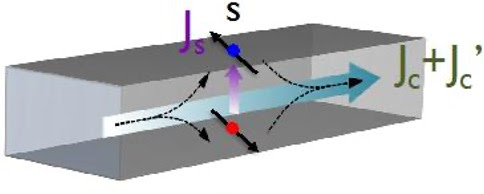
I'd written here about the spin Hall effect and its inverse, which were only "discovered" relatively recently.  In brief, because of strong spin-orbit coupling (SOC) effects on the electronic structure of comparatively heavy metals (Pt, Ta, W), passing a current through a thin film strip of such a material generates a spin current, leading to the accumulation of spin at the top and bottom of the strip.  If those interfaces are in contact with magnetic materials, exchange processes can take place so that there is a net transfer of angular momentum between the metal and the magnetic system.  

There is actually a correction to the resistance of the SOC metal:  The spin accumulation can lead to a diffusive spin current between the top and bottom surfaces, which (thanks to the inverse spin Hall effect, ISHE) gives an additive kick to the charge current (and effectively lowers the resistance of the metal from what it would be in the absence of the spin Hall physics).  If the top and bottom interfaces are in contact with a magnetic system and therefore affect the spin accumulation, that correction can be modified depending on the orientation of the magnetization of the magnetic material, leading to the spin Hall magnetoresistance.  

Spin Hall/inverse spin Hall
resistive correction,
adapted from here.

That's not the end of the story, however.  Even without an adjoining magnetic material, there is an additional magnetoresistive correction, \(\delta \rho(\mathbf{H})\) to the resistivity of the SOC metal.  If the magnetic field has a component transverse to the direction of the SHE accumulated spins, the spins will precess about that field, and that can affect the ISH correction to the resistivity.  This was predicted in 2007 by Dyakanov (arxiv, PRL), and it was found experimentally several years later, as reported in PRL (arxiv version here).  There are readily measurable effects in both the longitudinal resistivity \(\rho_{xx}\) (voltage measured along the direction of the current) and the transverse resistivity \(\rho_{xy}\) (voltage measured transverse to the current, as in the Hall effect, but this holds even when the external magnetic field is in the plane of the film).

Hanle magnetoresistance idea, 
adapted from here.

This correction is called the Hanle magnetoresistance.  

(Aside:  There is some interesting scientific history behind the name.  Hanle was the first to explain an atomic physics optical effect, where the precession of magnetic moments of a gas of atoms in a magnetic field affects the polarization of light passing through the gas.  In condensed matter, the name "Hanle effect" shows up in discussions of spin transport in metals.  The first time I ever encountered the term was in this paper, which foreshadows the discovery of giant magnetoresistance.  A ferromagnetic emitter contact is used to inject spin-polarized electrons into a non-magnetic metal, aluminum.  Those electrons diffuse over to a second ferromagnetic collector contact, where their ability to enter that contact (and hence the resistance of the gadget) depends on the relative alignment of the spins and the magnetization of the collector.  If there is a magnetic field perpendicular to the plane of the device, the spins precess while the electrons diffuse, and one can analyze the magnetoresistance to infer the spin relaxation time in the metal.)

One of my students and I have been scratching our heads trying to see if we really understand the Hanle magnetoresistance, which we have been measuring recently as a by-product of other work.  I think it's pretty amazing that we are still discovering new effects in something as simple as the resistance of a metal in a magnetic field.

Saturday, November 13, 2021

The community of department chairs

For the vast majority, there is no formal training process that professors go through before-hand to become chair or head of a department.  That makes access to the experiences and knowledge of others an invaluable resource.  In recent years, the APS has been sponsoring conferences of physics (or physics & astronomy) department chairs, and that's great, but pre-dating that have been electronic mailing lists for department chairs and heads*.  There is a long-standing, somewhat appropriately named "Midwest Physics Department Chairs" email listserv, and similarly there is an analogous American Astronomical Society astronomy chairs listserv.  

The chairs mailing list has been a great way to learn how processes work at other places, and to get advice or sanity checks.  Sometimes it can be very helpful to be able to say to your administration, "here is how everyone else does this."  Not everything translates, as large public universities have some real structural differences in operations compared to private universities, but it's still been informative. Examples of recent discussion topics in no particular order:

  • Rough startup costs for hires in different subfields (and how those costs are borne between departments, deans, provosts, etc.)
  • Qualifying/candidacy exams - what they cover (undergrad v grad), their value or lack thereof
  • Promotion and tenure processes 
  • Diversity/equity/inclusion at all levels
  • Graduate admissions in the post-standardized-test era
  • International students in the era of covid + recent changes in student visa policies
  • Various curricular issues (incorporating computation; lab staffing)
  • Mental health at all levels (undergrads, grad students, faculty, staff)

The group also has an annual get-together.  Last weekend I attended a meeting (face to face!) of about 30 physics department chairs at the exotic O'Hare Airport Hilton in Chicago.  While not everyone was able to make it, it was helpful to talk and compare notes.  People had a lot to say about teaching methods and what will stick around post-pandemic.  It was also very informative to learn what it takes financially and in terms of personnel to support a successful bridge program.  

Being chair or head can be isolating, and it's good having a community of people who understand the weird issues that can come up.  

* The definitions are not rigid, but a chair is often elected and expected to make decisions through consensus and voting, while a head is appointed and typically has more autonomy and authority.  As one former head at a big place once told me, though, you basically need consensus as a head, too, otherwise you can't get anything done.

Saturday, November 06, 2021

The noise is the signal

 I am about to attend a gathering of some physics department chairs/heads from around the US, and I'll write some about that after the meeting, but I wanted to point out a really neat paper (arxiv version here) in a recent issue of Science.  A group at Leiden has outfitted their scanning tunneling microscope with the ability to measure not just the tunneling current, but the noise in the tunneling current, specifically the "shot noise" that results out of equilibrium because charge is transported by the tunneling of discrete carriers.  See here for a pretty extensive discussion about how charge shot noise is a way to determine experimentally whether electrons are tunneling one at a time independently, or whether they are, for example, being transported two at a time because of some kind of pairing.

Adapted from Fig. 1 of this paper.
The experiment is quite pretty, looking at disordered thin films of TiN, with a macroscopic superconducting transition temperature of \(T_{c} =\) 2.95 K.  With the shot noise measurement, the experimenters see enhanced noise at low applied voltages consistent with pairing (with pairs being transported presumably by the process of Andreev reflection).  The interesting point is that this enhanced noise persists up to temperatures as high as 2.7 times \(T_{c}\), despite the fact that the tunneling conductance \(dI/dV\) shows no sign of a gap or pseudogap up there.  This implies that superconductivity in this material dies as \(T\) exceeds \(T_{c}\) not because the pairing between electrons falls apart, but instead because of the loss of the global coherence needed for the superconducting state.  That's an exciting result.  

I'm a big fan of noise measurements and applying them to a broader class of condensed matter systems.  We'd seen enhanced noise in cuprate tunnel junctions above \(T_{c}\) and at large biases, as mentioned here, but in the cuprates such persistence of pairing is less surprising than in the comparatively "simple" TiN system.  Noise measurements on demand via STM should be quite the enabling capability!

Sunday, October 24, 2021

The physics of ornithopters

One thing that the new Dune film captures extremely well is the idea that the primary small-capacity air transportation mode on Arrakis is travel by ornithopter.  The choice of flapping wings as a lift/propulsion mechanism can be in-fictional-universe justified by the idea that jet turbines probably won't do well in an atmosphere with lots of suspended dust and sand, especially on take-off and landing.  Still, I think Frank Herbert decided on ornithopters because it just sounded cool.

The actual physics and engineering of flight via flapping wings is complicated.  This site is a good place to do some reading.  The basic idea is not hard to explain.  To get net lift, in the cyclical flapping motion of a wing, somehow the drag force pushing downward on the wing during the upstroke has to be more than balanced by the flux of momentum pushed downward on the wing's downstroke.  To do this, the wing's geometry can't be unchanging during the flapping.  The asymmetry between up and down strokes is achieved through the tilting (at the wing base and along the wing) and flexing of the wing during the flapping motion.  

The ornithopters in the new movie have wings on the order of 10 m long, and wing motions that look like those of a dragonfly, and the wings are able to flap up and down and an apparent frequency of a couple of hundred hertz (!).  If you try to run some numbers on the torque, power, and material strength/weight that would be required to do this, you can see pretty quickly why this has not worked too well yet as a strategy on earth.   (As batteries, motor technology, and light materials continue to improve, perhaps ornithopters will become more than a fun hobby.)  

This issue - that cool gadgets in sci-fi or superhero movies would need apparently unachievable power densities at low masses - is common (see, e.g., Tony Stark's 3 GW arc reactor that fits in your hand, weighs a few pounds, and somehow doesn't have to radiate GW of waste heat), and that's ok; the stories are not meant to be too realistic. Still, the ornithopter fulfills its most important purpose in the movie:  It looks awesome.  

Sunday, October 17, 2021

Brief items - Sarachik, Feynman, NSF postdocs and more

 Here are several items of interest:

  • I was saddened to learn of the passing of Myriam Sarachik, a great experimental physicist and a generally impressive person.  I was thinking about writing a longer piece about her, but this New York Times profile from last year is better than anything I could do.  This obituary retells the story to some degree. (I know that it's pay-walled, but I can't find a link to a free version.)  In the early 1960s, after fighting appalling sexism to get a doctorate and a position at Bell Labs, she did foundational experimental work looking at the effect of dilute magnetic impurities in the conduction of nonmagnetic metals.  For each impurity, the magnetic atom has an unpaired electron in a localized orbitals.  A conduction electron of opposite spin could form a singlet to fill that orbital, but the on-site Coulomb repulsion of the electron already there makes that energetically forbidden except as a virtual intermediate state for a scattering process.  The result is that scattering by magnetic impurities gets enhanced as \(T\) falls, leading to an upturn in the resistivity \(\rho(T)\) that is logarithmic in \(T\) at low temperatures.  Eventually the localized electron is entangled with the conduction electrons to form a singlet, and the resistivity saturates.  This is known as the Kondo Effect based on the theoretical explanation of the problem, but Sarachik's name could credibly have been attached.  Her family met with a personal tragedy from which it took years to recover.  Later in her career, she did great work looking at localization and the metal-insulator transition in doped semiconductors.  She also worked on the quantum tunneling of magnetization in so-called single-molecule magnets, and was a key player in the study of the 2D metal-insulator transition in silicon MOSFETs.  I was fortunate enough to meet her when she came through Rice in about 2003, and she was very generous in her time meeting with me when I was a young assistant professor.  Sarachik also had a great service career, serving as APS President around that time.  Heck of a career! 
  • The audio recordings of the famous Feynman Lectures on Physics are now available for free to stream from Caltech.  You can also get to these from the individual lectures by a link on the side of each page.
  • There is a new NSF postdoctoral fellowship program for math and physical sciences.  I would be happy to talk to anyone who might be interested in pursuing one of these who might want to work with me.  Please reach out via email.
  • I've written before about the "tunneling time" problem - how long does quantum mechanical tunneling of a particle through a barrier take?  Here is an experimental verification of one of the most counterintuitive results in this field:  the farther "below" the barrier the particle is (in the sense of having a smaller fraction of the kinetic energy needed classically to overcome the potential barrier), the faster the tunneling.  A key experimental technique here is the use of a "Larmor clock", with the precession of the spin of a tunneling atom acting as the time-keeping mechanism.
  • Did you know that it is possible, in Microsoft Word, to turn on some simple LaTeX-style symbolic coding?  The key is to enable "Math Autocorrect", and then typing \alpha will automatically be turned into \(\alpha\).  (I know act like doing scientific writing in Word is heretical, but not everyone in every discipline is facile with LaTeX/Overleaf.)

Sunday, October 10, 2021

The Purcell effect - still mind-blowing.

The Purcell effect is named after E. M. Purcell, a Nobel-winning physicist who also was a tremendous communicator, author of one of the great undergraduate textbooks and a famous lecture about the physical world from the point of view of, e.g., a bacterium.  I've written about this before here, and in a comment I include the complete (otherwise paywalled) text of the remarkable original "paper" that describes the effect.

When we calculate things like the Planck black-body spectrum, we use the "density of states" for photons - for a volume \(V\), we are able to count up how many electromagnetic modes are available with frequency between \(\nu\) and \(\nu + \mathrm{d}\nu\), keeping in mind that for each frequency, the electric field can be polarized in two orthogonal directions.  The result is \( (8\pi/c^3)\nu^2 \mathrm{d}\nu\) states per unit volume of "free space".

In a cavity, though, the situation is different - instead, there is, roughly speaking, one electromagnetic mode per the bandwidth of the cavity per the volume of the cavity.  In other words, the effective density of states for photons in the cavity is different than that in free space.  That has enormous ramifications:  The rates of radiative processes, even those that we like to consider as fundamental, like the rate at which electrically excited atoms radiatively decay to lower states state, can be altered in a cavity.  This is the basis for a lot of quantum optics work, as in cavity quantum electrodynamics.  Similarly, the presence of an altered (from free space) photon density of states also modifies the spectrum of thermal radiation from that cavity away from the Planck black-body spectrum.  

Consider an excited atom in the middle of such a cavity.  When it is going to emit a photon, how does it "know" that it's in a cavity rather than in free space, especially if the cavity is much larger than an atom?  The answer is, somehow through the electromagnetic couplings to the atoms that make up the cavity.  This is remarkable, at least to me.   (It's rather analogous to how we picture the Casimir effect, where you can think about the same physics either, e.g., as due to altering local vacuum fluctuations of the EM field in the space between conducting plates, or as due to fluctuating dipolar forces because of fluctuating polarizations on the plates.)

Any description of a cavity (or plasmonic structure) altering the local photon density of states is therefore really short-hand.  In that approximation, any radiative process in question is tacitly assuming that an emitter or absorber in there is being influenced by the surrounding material.  We just are fortunate that we can lump such complicated, relativistically retarded interactions into an effective photon density of states that differs from that in free space. 


Tuesday, October 05, 2021

Spin glasses and the Nobel

The Nobel Prize in physics this year was a bit of a surprise, at least to me.  As one friend described it, it's a bit of a Frankenprize, stitched together out of rather disparate components.  (Apologies for the slow post - work was very busy today.)  As always, it's interesting to read the more in-depth scientific background of the prize.  I was unfamiliar with the climate modeling of Manabe and Hasselmann, and this was a nice intro.

The other prize recipient was Giorgio Parisi, a statistical mechanician whose key cited contribution was in the theory of spin glasses, but was generalizable to many disordered systems with slow, many-timescale dynamics including things like polymers and neural networks.  

The key actors in a spin glass are excess spins - local magnetic moments that you can picture as little magnetic dipoles. In a generic spin glass, there is both disorder (as shown in the upper panel of the cartoon, spins - in this case iron atoms doped into copper - are at random locations, and that leads to a broad distribution of spin-spin interactions in magnitude and sign) and frustration (interactions such that flipping spin A to lower its interaction energy with spin B ends up raising the interaction energy with spin C, so that there is no simple configuration of spins that gives a global minimum of the interaction energy).  One consequence of this is a very complicated energy landscape, as shown in the lower panel of the cartoon.  There can be a very large number of configurations that all have about the same total energy, and flipping between these configurations can require a lot of energy such that it is suppressed at low temperatures.  These magnetic systems then end up having slow, "glassy" dynamics with long, non-exponential relaxations, in the same way that structural glasses (e.g., SiO2 glass) can get hung up in geometric configurations that are not the global energetic minimum (crystalline quartz, in the SiO2 case).  

The standard tools of statistical physics are difficult to apply to the glassy situation.  A key assumption of equilibrium thermodynamics is that, for a given total energy, a system is equally likely to be found in any microscopic configuration that has that total energy.  Being able to cycle through all those configurations is called ergodicity.  In a spin glass at low temperatures, the potential landscape means that the system can get easily hung up in a local energy minimum, becoming non-ergodic.  

An approach that Parisi took to this problem involved "replicas", where one considers the whole system as an ensemble of replica systems, and a key measure of what's going on is the similarity of configurations between the replicas.  Parisi himself summarizes this in this pretty readable (for physicists) article.  One of Parisi's big contributions was showing that the Ising spin glass model of Sherrington and Kirkpatrick is exactly solvable.

I learned about spin glasses as a doctoral student, since the interacting two-level systems in structural glasses at milliKelvin temperatures act a lot like a spin glass (TLS coupled to each other via a dipolar elastic interaction, and sometimes an electric dipolar interaction), complete with slow relaxations, differences between field-cooled and zero-field-cooled properties, etc.  

Parisi has made contributions across many diverse areas of physics.  Connecting his work to that of the climate modelers is a bit of a stretch thematically - sure, they all worry about dynamics of complex systems, but that's a really broad umbrella.  Still, it's nice to see recognition for the incredibly challenging problem of strongly disordered systems.

Sunday, October 03, 2021

Annual Nobel speculation thread

Once more, the annual tradition:  Who do people think will win the Nobel this year in physics or chemistry?  I have repeately and incorrectly suggested Aharonov and Berry for geometric phases.  There is a lot of speculation on social media about Aspect, Zeilinger, and Clauser for Bell's inequality tests.  Social media speculation has included quantum cascade lasers as well as photonic bandgap/metamaterials. Other suggestions I've seen online have included superconducting qubits (with various combinations of people) and twisted bilayer graphene, though both of those may be a bit early.  


Tuesday, September 28, 2021

Science/tech consulting in creative arts


I've watched the first two episodes of the new adaptation of Foundation.  It surely looks gorgeous, though there are some script challenges (even apart from the challenge of trying to adapt an enormous book series that was always long on ideas and short on character development).   The issues I've spotted seem mostly to be ones of poor script editing for consistency.  (The emperor of the Galactic Empire says in the first episode that the imperial population is 8 trillion, and then in the second episode a character says that the core worlds alone have a population of 40 trillion.  The latter number is more reasonable, given the size of Asimov's empire.)  

Watching this, I again think it would be great fun to do scientific/technical consulting for TV, movies, and even books. I'm on the list for the Science and Entertainment Exchange, though all I've ever done is give a tiny bit of feedback to a would-be author.  (My expertise probably looks too narrow, and not living in southern California seems to be a major filter.)  

It feels like there are some similarities to the role of science in public policy.  In the creative productions, science can contribute (and these media can be a great way of getting scientific ideas out into the public), but in the end plot and what can practically be implemented will always drive the final product.  In policy, science and technical knowledge should definitely factor in when relevant, but fundamentally there are social and political factors that can overwhelm those influences in decision-making.  Now back to our regularly scheduled psychohistorical crisis....


Wednesday, September 22, 2021

DOE Experimental Condensed Matter PI meeting, Day 3

Here are some tidbits from the last day of this year's meeting.  (I didn't really get to see the other posters in my own poster session, so apologies for missing those.  For the curious:  the meeting attendees alternate between posters and 15 minute talks from year to year.)

  • It's been known for a while that combining magnetism with topological insulator materials can lead to a rich phase diagram.  Tuning composition is a powerful tool.  Likewise, the van der Waals nature of these systems mean that it's possible to look systematically through a family of related materials.
  • Tuning composition in flat-band kagome metals is also of interest.
  • I had not appreciated just how important specific crystal growth approaches (e.g., rapid quenching vs. slow annealed cooling) are to the properties of some magnetic/topological materials, such as Fe5GeTe2.  
  • Strain can be a powerful tool for tuning electronic topology in some materials such as ZrTe5, and driving certain phonon modes via laser offers the potential of controlled switching of topological properties.
  • Quantum oscillations (e.g., magnetization as a function of 1/H) are a conventional way to learn about Fermi surfaces, and it is always bizarre when that kind of response shows up in a correlated material that is nominally an insulator, or in thermal transport but not electrical transport.
  • Speaking of quantum oscillations in insulators, how about thermal transport in the spin liquid phase of \(\alpha\)-RuCl3?  Looks like some kind of bosonic edge mode is responsible.
  • If transition metal dichalcogenides are starting to bore you, perhaps you'd be more interested in trichalcogenides, which can be grown as individual 1D chains within carbon and boron nitride nanotubes.
Thanks to everyone for making the meeting enjoyable and informative, even if we couldn't get together in a random Marriott in Maryland this time.  

Tuesday, September 21, 2021

DOE Experimental Condensed Matter PI meeting, Day 2

 More highlights from the meeting.  Office hours for my class conflicted with a couple of the talks, so these are briefer than I would've liked.

  • It is possible to use coherent x-ray scattering to look at time variations in the domain structure of an antiferromagnet.  In the magnetic diffraction pattern there is speckle near the magnetic Bragg spots that bops around as the domain structure fluctuates.
  • Amorphous magnetic alloys can show some really wild spin textures.  
  • By growing a few nanometers of a paramagnetic metal, Bi2Ir2O7, on top of an insulating spin ice, Dy2Ti2O7, it's possible to get enough coupling that field-driven spin ice transitions can generate magnetoresistance signatures in the metal layer.
  • Square planar nickelates can look a lot like the copper oxide superconductors in terms of band dispersion and possible "strange" metallicity.
  • Some rare-earth intermetallic compounds can have an impressively rich magnetic phase diagram.
  • I learned that some pyrochlore iridates can exhibit a kind of topological metallic state with giant anomalous Hall response.
  • I had not previously appreciated how wild it is that one can engineer ferroelectric response in stacks of 2D materials that are not intrinsically ferroelectric, as in hBN or even WSe2.
  • Ultrasound attenuation can be a heck of a tool for looking at superconductivity and other electronic transport properties.
  • Strontium titanate remains a really interesting test case for understanding exotic superconductivity, with its superconducting dome as a function of doping, very low carrier density, and incipient ferroelectricity.  Phonons + paraelectric fluctuations + spin-orbit coupling appear to be the big players. 
  • A related system in the sense of near-ferroelectricity and low carrier density is at interfaces of KTaO3.
  • This experiment in graphene/hBN/graphene stacks (with encapsulating hBN and graphite top and bottom gates) is an extremely pretty, tunable demonstration of superfluidity of bilayer excitons, an effect previously seen in one limit in GaAs systems.

Monday, September 20, 2021

DOE Experimental Condensed Matter PI meeting, Day 1

Somehow I found the first day of the virtual meeting more exhausting than when we do these things in person, probably because I had to go teach in the middle of the event.  A sampling of highlights:

  • Rather than relying on relatively crude methods to create defect centers in diamond for quantum sensing (or qubit purposes), one can use chemistry to build transition metal complexes with designer ligand fields (and hence energy level structures), as demonstrated here.
  • I know understand better why it has historically been so difficult to demonstrate, experimentally, that the quasiparticles in the fractional quantum Hall effect obey fractional (anyonic) statistics.  In an interferometer, it's critical to use screening (from top and bottom electron gases that act like capacitor plates) to reduce Coulomb interactions between edge states and the bulk. Once that's done, you can see clear evidence of fractional (anyonic) phase slips.
  • Some truly exceptional people can still do research even while being a university president.  At very low energies in an Ising ferromagnet with an in-plane magnetic field, hyperfine interactions can lead to hybridization of magnetic levels and the formation of "electronuclear" spin excitations.
  • Ultraclean ABC-stacked graphene trilayers can show remarkably rich response, dominated by strong electron-electron interaction effects.
  • High quality crystal growth can drastically lower the defect densities in transition metal dichalcogenides.  That makes it possible to construct bilayers of WSe2, for example, that can host apparent excitonic condensates.  Similar physics can be seen in MoSe2/WSe2 bilayers, where it is clear that exciton-exciton interactions can be very strong.
  • Pulling and pushing on a sample can lead to elastocaloric effects (like when a rubber band cools upon being stretched), and these can reveal otherwise hidden properties and phase transitions.
More tomorrow.  (One fun idea from a colleague:  Perhaps the program officers have hidden a secret easter egg token somewhere in the Gather virtual poster area, and whoever finds it gets a bonus award supplement to support a summer undergrad....)

DOE Experimental Condensed Matter Physics PI meeting, 2021

Every two years, the US Department of Energy Experimental Condensed Matter Physics program has a principal investigator meeting, and I've written up highlights of these for a while (for 2019, see a, b, c;  2017, see a, b, c; for 2015 see a, b, c; for 2013 see a, b).

The meetings have always been very educational for me.  They're a chance to get a sense of the breadth of the whole program and the research portfolio.  It is unfortunate that the covid pandemic has forced this year's meeting to be virtual.  I'll do my best to summarize some tidbits in posts over the next three days.

Friday, September 17, 2021

Moiré materials and the Mott transition

There are back-to-back papers in Nature this week, one out of Columbia and one out of Cornell, using bilayers of transition metal dichalcogenides to examine the Mott transition.  (Sorry for the brevity - I'm pressed for time right now, but I wanted to write something....)

As I described ages ago in here, imagine a lattice of sites, each containing one electron.  While quantum statistics would allow each site to be doubly occupied (thanks to spin), if the on-site electron-electron repulsion \(U\) is sufficiently strong (large compared to the kinetic energy scale \(t\) associated with hopping between neighboring sites), then the interacting system will be an insulator even though the non-interacting version would be a metal.  Moving away from this half-filling condition, you can get conduction, just as having an empty site allows those sliding tile puzzles to work.

As discussed here, in bilayers of 2D materials can lead to the formation of a moiré lattice, where the interlayer interactions result in an effective periodic array of potential wells.  The Columbia folks got a moiré pattern by using a 4-5 degree twisted bilayer of WSe2, while the Cornell folks instead used an aligned bilayer of MoTe2 and WSe2 (where the moiré comes from the differing lattice constants).  In both cases, you end up with a triangular moiré lattice (encapsulated in hBN to provide a clean charge environment and protection from the air).  

The investigators are able to tune the systems in multiple ways.  With overall gate voltage, they can capacitively tune the "filling", the ratio of number of "free" charges to number of moiré lattice sites.  By adjusting top gate vs. back gate, they can tune the vertical electric field across the bilayer, and that is a way of tuning interactions by pushing around localized wavefunctions for the lattice sites.  

Both groups find that they can tune in/out of a Mott insulating phase when they're at one carrier per moiré lattice site.  Interestingly, both groups see that the Mott transition is continuous (second-order) - there is no sudden onset of insulating response as a function of tuning either knob.  Instead, there appears to be quantum critical scaling, and regions of linear-in-\(T\) temperature dependence of the resistivity (a possible indicator of a strange metal) on either side of the insulating region.  The Cornell folks are able to do magnetic circular dichroism measurements to confirm that the transition does not involve obvious magnetic ordering. 

This is very pretty work, and it shows the promise of the moiré lattice approach for studying fundamental issues (like whether or not the Mott transition in a triangular lattice is continuous).  I'm sure that there will be much more to come in these and related systems.


Monday, September 06, 2021

What is the spin Hall effect?

The Hall Effect is an old (1879) story, told in first-year undergraduate physics classes for decades. Once students are told about the Lorentz force law, it's easy to make a handwave classical argument that something like the Hall Effect has to exist:  Drive a current in a conductor in the presence of a magnetic induction \(\mathbf{B}\).  Charged particles undergo a \(q \mathbf{v} \times \mathbf{B}\) force that pushes them transverse to their original \(\mathbf{v}\) direction.  In a finite slab of material with current perpendicular to \(\mathbf{B}\), the particles have to pile up at the transverse edge, leading to the development of a (Hall) voltage perpendicular to the direction of current flow and the magnetic induction.  You can measure the Hall voltage readily, and it's used for sensing magnetic fields, as well as figuring out charge carrier densities in materials.

The spin Hall effect, in contrast, is a much newer idea.  It was first proposed by Dyakonov and Perel in 1971 as an extrinsic effect (that is, induced by scattering from impurities in a material), and this was revisited in 1999 by Hirsch and others.  It's also possible to have an intrinsic spin Hall effect (proposed here and here) due just to the electronic structure of a material itself, not involving impurities.

Adapted from here.

So what is the SHE?  In some non-magnetic conductors, in the absence of any external magnetic field, a charge current (say in the \(+x\) direction) results in a build-up of electrons with spin polarized up (down) along the \(z\) direction along the positive (negative) \(y\) edge of the material, as shown in the bottom left drawing of the figure.  Note that there is no net charge imbalance or transverse voltage - just a net spin imbalance. 

The SHE is a result of spin-orbit coupling - it's fundamentally a relativistic effect (!).  While we static observers see only electric fields in the material, the moving charge carriers in their frame of reference see effective magnetic fields, and that affects carrier motion.  In the extrinsic SHE, scattering of carriers from impurities ends up having a systematic spin dependence, so that spin-up carriers are preferentially scattered one way and spin-down carriers are scattered the other.  In the intrinsic SHE, there ends up being a spin-dependent term in the semiclassical velocity that one would get from the band structure, because of spin-orbit effects.  (The anomalous Hall effect, when one observes a Hall voltage correlated with the magnetization of a magnetic conductor, is closely related.  The net charge imbalance shows up because the populations of different spins are not equal in a ferromagnet.)  The result is a spin current density \(\mathbf{J}_{\mathrm{s}}\) that is perpendicular to the charge current density \(\mathbf{J}_{\mathrm{c}}\), and is characterized by a (material-dependent) spin Hall angle, \(\theta_{\mathrm{SH}}\), so that \(J_{\mathrm{s}} = (\hbar/2e)\theta_{\mathrm{SH}}J_{\mathrm{c}}\).

There is also an inverse SHE:  if (appropriately oriented) spin polarized charge carriers are injected into a strong spin-orbit coupled non-magnetic metal (say along \(+x\) as in the bottom right panel of the figure), the result is a transverse (\(y\)-directed) charge current and transverse voltage build-up.  (It's this inverse SHE that is used to detect spin currents in spin Seebeck effect experiments.)

The SHE and ISHE have attracted a lot of interest for technological applications.  Generating a spin current via the SHE and using that to push around the magnetization of some magnetic material is called spin orbit torque, and here is a recent review discussing device ideas.


Wednesday, September 01, 2021

Rice University physics faculty search in experimental quantum science and technology

The Department of Physics and Astronomy at Rice University invites applications for tenure-track faculty positions in the broad area of experimental quantum science and technology. This encompasses quantum information processing, quantum sensing, quantum communication, quantum opto-mechanics, and quantum simulation in photonic, atomic/ionic, quantum-material, and other solid-state platforms. We seek outstanding scientists whose research will complement and extend existing activities in these areas within the Department and across the University. In addition to developing an independent and vigorous research program, the successful applicants will be expected to teach, on average, one undergraduate or graduate course each semester, and contribute to the service missions of the Department and University. The Department anticipates making appointments at the assistant professor level. A Ph.D. in physics or related field is required.

Beginning September 1, 2021, applications for this position must be submitted electronically at apply.interfolio.com/92734 .

Applications for this position must be submitted electronically. Applicants will be required to submit the following: (1) cover letter; (2) curriculum vitae; (3) statement of research; (4) statement on teaching; (5) statement on diversity, mentoring, and outreach; (6) PDF copies of up to three publications; and (7) the names, affiliations, and email addresses of three professional references. Rice University, and the Department of Physics and Astronomy, are strongly committed to a culturally diverse intellectual community. In this spirit, we particularly welcome applications from all genders and members of historically underrepresented groups who exemplify diverse cultural experiences and who are especially qualified to mentor and advise all members of our diverse student population.We will begin reviewing applications November 15, 2021. To receive full consideration, all application materials must be received by January 1, 2022. The expected appointment date is July, 2022.  

Rice University is an Equal Opportunity Employer with commitment to diversity at all levels, and considers for employment qualified applicants without regard to race, color, religion, age, sex, sexual orientation, gender identity, national or ethnic origin, genetic information, disability or protected veteran status.